

KLI Colloquia are invited research talks of about an hour followed by 30 min discussion. The talks are held in English, open to the public, and offered in hybrid format.
Join via Zoom:
https://us02web.zoom.us/j/5881861923?omn=85945744831
Meeting ID: 588 186 1923
Fall-Winter 2026/27 KLI Colloquium Series
1 October 2026 (Thurs) 3-4:30 PM CET 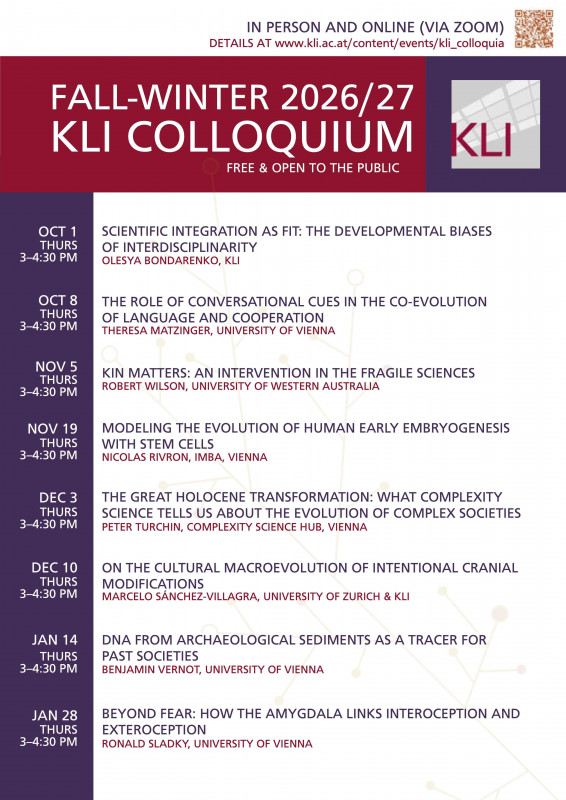
Scientific Integration as Fit: The Developmental Biases of Interdisciplinarity
Olesya BONDARENKO (KLI)
8 October 2026 (Thurs) 3-4:30 PM CET
The Role of Conversational Cues in the Co-Evolution of Language and Cooperation
Theresa MATZINGER (University of Vienna)
5 November 2026 (Thurs) 3-4:30 PM CET
Kin Matters: An Intervention in the Fragile Sciences
Robert A. WILSON (University of Western Australia)
19 November 2026 (Thurs) 3-4:30 PM CET
Modeling the Evolution of Human Early Embryogenesis with Stem Cells
Nicolas RIVRON (Institute of Molecular Biotechnology/IMBA, Vienna)
3 December 2026 (Thurs) 3-4:30 PM CET
Peter TURCHIN (Complexity Science Hub, Vienna)
10 December 2026 (Thurs) 3-4:30 PM CET
On the Cultural Macroevolution of Intentional Cranial Modifications
Marcelo SÁNCHEZ-VILLAGRA (University of Zurich)
14 January 2027 (Thurs) 3-4:30 PM CET
DNA from Archaeological Sediments as a Tracer for Past Societies
Benjamin VERNOT (University of Vienna)
28 January 2027 (Thurs) 3-4:30 PM CET
Beyond Fear: How the Amygdala Links Interoception and Exteroception
Ronald SLADKY (University of Vienna)
KLI Colloquia 2014 – 2026
Event Details

Topic description:
Waddington’s epigenetic landscape is an intuitive metaphor for the developmental and evolutionary potential of biological regulatory processes. It emphasises time-dependence and transient behaviour. Nowadays, we can derive this landscape by modelling a specific regulatory network as a dynamical system and calculating its so-called potential surface. In this sense, potential surfaces are the mathematical equivalent of the Waddingtonian landscape metaphor. In order to fully capture the time-dependent (non-autonomous) transient behaviour of biological processes, we must be able to characterise potential landscapes and how they change over time. In this talk, I will present a methodological framework that I developed as part of my PhD project which allows us to classify different transient behaviours in non-autonomous systems. I will then briefly show how applying this framework to the gap gene network in flies is helping us understand the evolution of the different modes of segmentation in arthropods. I will use this work to argue that dynamical systems concepts are especially well-suited for the study of EvoDevo, and to try to illustrate the need for a primer bringing these two disciplines together.
Biographical note:
Berta Verd holds a Bachelor´s degree in Mathematics from Polytechnic University of Catalonia (UPC), Barcelona and Master´s degrees from Kings College as well as Imperial College, London. She worked on her PhD thesis at the Centre for Genomic Regulation at the Pompeu Fabra University, Barcelona and at the Wissenschaftskolleg zu Berlin. She has recently completed her PhD and is now a Postdoctoral Fellow at the KLI.
