

KLI Colloquia are invited research talks of about an hour followed by 30 min discussion. The talks are held in English, open to the public, and offered in hybrid format.
Join via Zoom:
https://us02web.zoom.us/j/5881861923?omn=85945744831
Meeting ID: 588 186 1923
Fall-Winter 2026/27 KLI Colloquium Series
1 October 2026 (Thurs) 3-4:30 PM CET 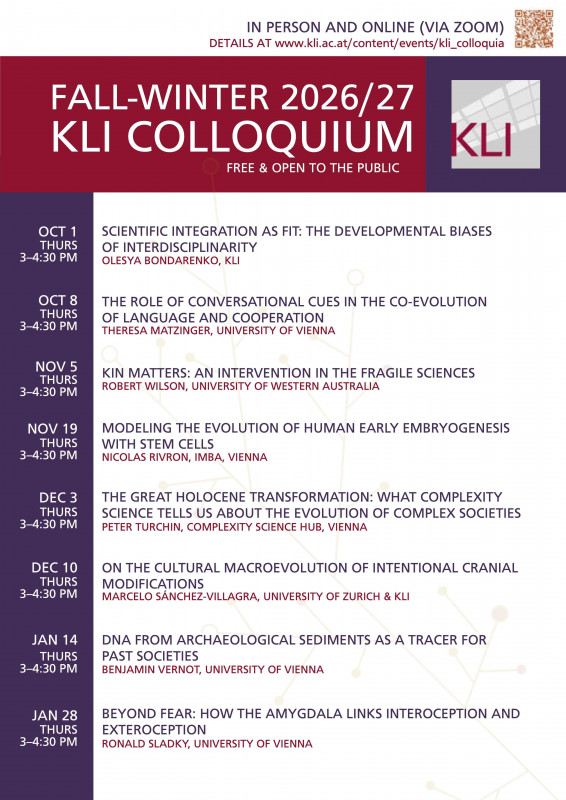
Scientific Integration as Fit: The Developmental Biases of Interdisciplinarity
Olesya BONDARENKO (KLI)
8 October 2026 (Thurs) 3-4:30 PM CET
The Role of Conversational Cues in the Co-Evolution of Language and Cooperation
Theresa MATZINGER (University of Vienna)
5 November 2026 (Thurs) 3-4:30 PM CET
Kin Matters: An Intervention in the Fragile Sciences
Robert A. WILSON (University of Western Australia)
19 November 2026 (Thurs) 3-4:30 PM CET
Modeling the Evolution of Human Early Embryogenesis with Stem Cells
Nicolas RIVRON (Institute of Molecular Biotechnology/IMBA, Vienna)
3 December 2026 (Thurs) 3-4:30 PM CET
Peter TURCHIN (Complexity Science Hub, Vienna)
10 December 2026 (Thurs) 3-4:30 PM CET
On the Cultural Macroevolution of Intentional Cranial Modifications
Marcelo SÁNCHEZ-VILLAGRA (University of Zurich)
14 January 2027 (Thurs) 3-4:30 PM CET
DNA from Archaeological Sediments as a Tracer for Past Societies
Benjamin VERNOT (University of Vienna)
28 January 2027 (Thurs) 3-4:30 PM CET
Beyond Fear: How the Amygdala Links Interoception and Exteroception
Ronald SLADKY (University of Vienna)
KLI Colloquia 2014 – 2026
Event Details
Topic description:
Interacting microbes are capable of implementing complex functions such as resistant starch degradation in human guts, denitrification of water in wastewater treatment or ABx tolerance in disease-related biofilms. To better understand and manage microbial functions we require understanding of the intrinsic and environmental factors that drive microbial community organization and shape collective, microbial functions. I will present my recent research on structure-function mapping performed on divers microbial communities from selected habitats. I will bridge between the predictability of environmental variation in river biofilms, the competition among functional guilds in the lung microbiome of persons with cystic fibrosis, the self-organisation of gut microbiota with heterogeneous memory capacity and the identification of predominant organization principles inferred from time-series data of microbial composition.
Bibliographical note:
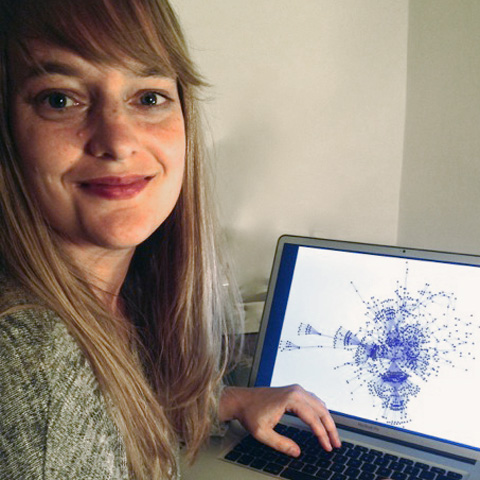
Dr. Stefanie Widder is a computational biologist, currently a senior fellow at the KLI and affiliated with the Medical University of Vienna. She is working on the systems biology of complex communities, in particular microbial consortia and gene regulatory networks. Her research aims at predictive understanding of complex community functions that find application in human health and related fields (e.g. Widder et al. ISMEJ 2016).
