

KLI Colloquia are invited research talks of about an hour followed by 30 min discussion. The talks are held in English, open to the public, and offered in hybrid format.
Join via Zoom:
https://us02web.zoom.us/j/5881861923?omn=85945744831
Meeting ID: 588 186 1923
Fall-Winter 2026/27 KLI Colloquium Series
1 October 2026 (Thurs) 3-4:30 PM CET 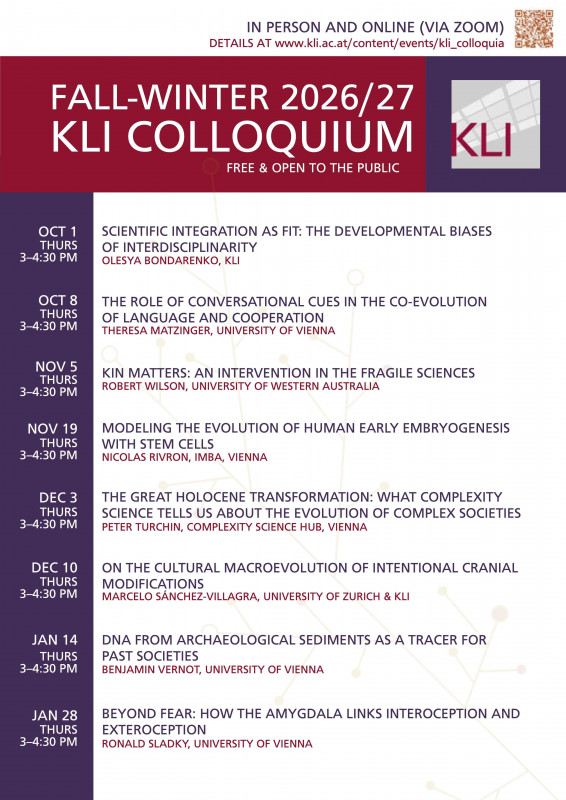
Scientific Integration as Fit: The Developmental Biases of Interdisciplinarity
Olesya BONDARENKO (KLI)
8 October 2026 (Thurs) 3-4:30 PM CET
The Role of Conversational Cues in the Co-Evolution of Language and Cooperation
Theresa MATZINGER (University of Vienna)
5 November 2026 (Thurs) 3-4:30 PM CET
Kin Matters: An Intervention in the Fragile Sciences
Robert A. WILSON (University of Western Australia)
19 November 2026 (Thurs) 3-4:30 PM CET
Modeling the Evolution of Human Early Embryogenesis with Stem Cells
Nicolas RIVRON (Institute of Molecular Biotechnology/IMBA, Vienna)
3 December 2026 (Thurs) 3-4:30 PM CET
Peter TURCHIN (Complexity Science Hub, Vienna)
10 December 2026 (Thurs) 3-4:30 PM CET
On the Cultural Macroevolution of Intentional Cranial Modifications
Marcelo SÁNCHEZ-VILLAGRA (University of Zurich)
14 January 2027 (Thurs) 3-4:30 PM CET
DNA from Archaeological Sediments as a Tracer for Past Societies
Benjamin VERNOT (University of Vienna)
28 January 2027 (Thurs) 3-4:30 PM CET
Beyond Fear: How the Amygdala Links Interoception and Exteroception
Ronald SLADKY (University of Vienna)
KLI Colloquia 2014 – 2026
Event Details

Topic description:
Stromatolites are layered marine carbonates that were directly precipitated from ancient seawater in the presence of microorganisms and are the oldest so far known geological remnants of microbial life on Earth. During the course of the KLI colloquium talk, I will highlight the application and the potential of geochemical proxies, in particular the Rare Earth Elements (REE) and radiogenic Sm-Nd isotope systems, in marine chemical sediments to evaluate the physico-chemical conditions of ancient environments, i.e. potential habitat in which the earliest life on Earth may have thrived and established. Setting the reconstructed habitat in relationship to suggested biochemical models of the origin of life is essential to evaluate, if the stromatolite environment or similar habitats may be suitable for the origin establishment of life on our Earth.
Biographical note:
Sebastian Viehmann studied geology/palaeontology at the Rheinischen Friedrich-Wilhelms Universität Bonn and focused on the geochemical characterisation of 3.8 and 2.7 billion year old marine chemical sediments during his diploma thesis. He built up on this topic during his PhD at the Jacobs University Bremen and reconstructed the physico-chemical conditions of the atmosphere and hydrosphere on Earth in the time frame between 3.8 billion years ago until 534 million years ago. In summer 2017, he moved to the University of Vienna to merge the topics of biochemistry and geochemistry. He will apply geochemical analyses of stromatolites, i.e. marine layered carbonates that were precipitated in the presence of the microorganisms, to further understand the environmental conditions and habitats of the earliest life that is preserved in the geological rock record.
