

KLI Colloquia are invited research talks of about an hour followed by 30 min discussion. The talks are held in English, open to the public, and offered in hybrid format.
Join via Zoom:
https://us02web.zoom.us/j/5881861923?omn=85945744831
Meeting ID: 588 186 1923
Fall-Winter 2026/27 KLI Colloquium Series
1 October 2026 (Thurs) 3-4:30 PM CET 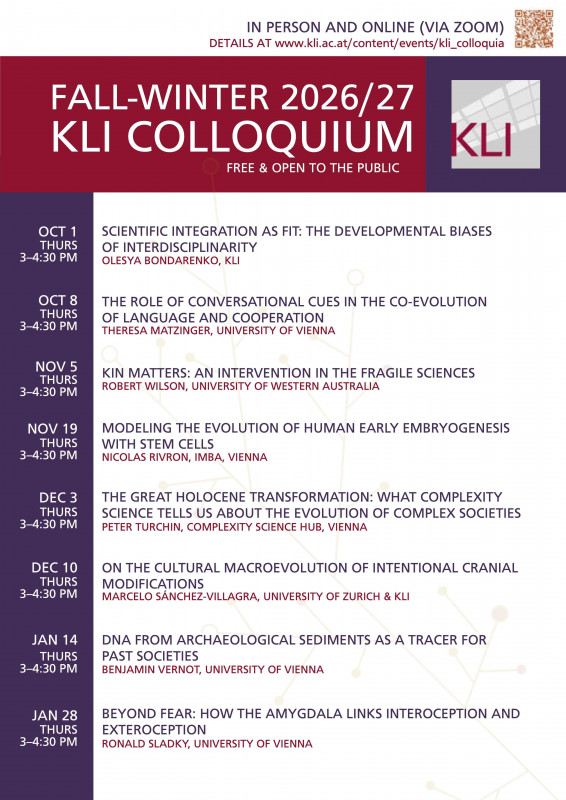
Scientific Integration as Fit: The Developmental Biases of Interdisciplinarity
Olesya BONDARENKO (KLI)
8 October 2026 (Thurs) 3-4:30 PM CET
The Role of Conversational Cues in the Co-Evolution of Language and Cooperation
Theresa MATZINGER (University of Vienna)
5 November 2026 (Thurs) 3-4:30 PM CET
Kin Matters: An Intervention in the Fragile Sciences
Robert A. WILSON (University of Western Australia)
19 November 2026 (Thurs) 3-4:30 PM CET
Modeling the Evolution of Human Early Embryogenesis with Stem Cells
Nicolas RIVRON (Institute of Molecular Biotechnology/IMBA, Vienna)
3 December 2026 (Thurs) 3-4:30 PM CET
Peter TURCHIN (Complexity Science Hub, Vienna)
10 December 2026 (Thurs) 3-4:30 PM CET
On the Cultural Macroevolution of Intentional Cranial Modifications
Marcelo SÁNCHEZ-VILLAGRA (University of Zurich)
14 January 2027 (Thurs) 3-4:30 PM CET
DNA from Archaeological Sediments as a Tracer for Past Societies
Benjamin VERNOT (University of Vienna)
28 January 2027 (Thurs) 3-4:30 PM CET
Beyond Fear: How the Amygdala Links Interoception and Exteroception
Ronald SLADKY (University of Vienna)
KLI Colloquia 2014 – 2026
Event Details
Topic description:
The existence of human female orgasm has posed a much-discussed challenge to evolutionary biologists and broader. What is its role? The evidence for any direct reproductive effect is lacking: women readily conceive without ever experiencing orgasm, and penetrative sex without additional clitoral stimulation is not the primary trigger of orgasm for females. To address the question, we focused on physiological proxy- the neuroendocrine hormonal surge that accompanies human female orgasm. Remarkably, this surge is similar to the neuroendocrine reflex which triggers ovulation in copulation-induced mammals, such as rabbits, ferrets or cats. This suggests that human female orgasm may be a vestige of an evolutionarily older reflex inducing ovulation, which lost its role with the evolution of endogenously regulated ovulatory cycle. Apart from endocrine similarities, two types of evidence support this idea. The first is that copulation-induced ovulation evolutionarily precedes spontaneous ovulation. The second is that female genital anatomy has changed to remove clitoris from copulatory canal concurrent with the evolution of spontaneous ovulation.
Apart from the particular work, I would like to invite everyone to discuss more general issues in evolutionary biology that are beautifully manifested in the discussions about female orgasm, such as the distinction between modification and origin of traits, the importance of function for demonstrating adaptation, and the focus on homology.
Biographical note:
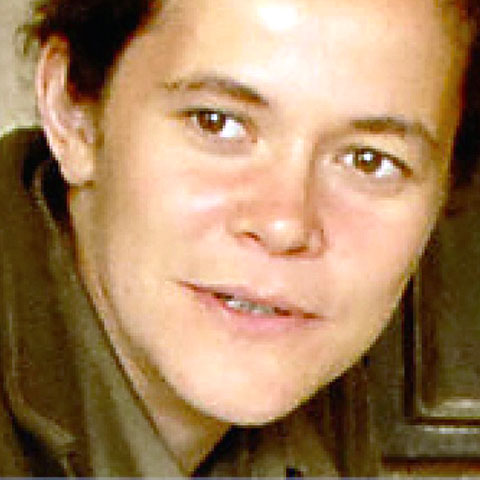
Mihaela Pavlicev is evolutionary biologist with a wide range of interests. After finishing her PhD in Ecology in Vienna, 2003, she joined Natural History Museum in Vienna to work on molecular phylogenetics of reptiles (with E. Haring, W. Mayer). This was followed by two consecutive postdoctoral appointments in evolutionary quantitative genetics, in St. Louis (with J. Cheverud) and in Oslo (with T. Hansen). Mihaela subsequently returned to Vienna as a postdoctoral fellow at KLI and lecturer at the University of Vienna, before taking a faculty position at the University of Cincinnati Medical School/ Cincinnati Children`s Hospital in Ohio in 2013.
Mihaela`s work has been focused around the influence of the structure of genotype-phenotype map on evolutionary response to selection, as well as the evolution of this map. Two aspects of the genotype-phenotype map, which is essentially an abstraction of developmental/physiological genetic structure, have been of particular interest: the evolution of gene effects and the impact of pleiotropic genes affecting multiple traits.
More recently, Mihaela started exploring how evolutionary approaches to studying variation of traits, both short- and long term, can be used to understand specific trait states, namely disease. Recent work includes theoretical and experimental work focusing on the evolution of mammalian pregnancy and its relevance for human medicine.
