
KLI Colloquia are invited research talks of about an hour followed by 30 min discussion. The talks are held in English, open to the public, and offered in hybrid format.
Join via Zoom:
https://us02web.zoom.us/j/5881861923?omn=85945744831
Meeting ID: 588 186 1923
Fall-Winter 2026/27 KLI Colloquium Series
1 October 2026 (Thurs) 3-4:30 PM CET 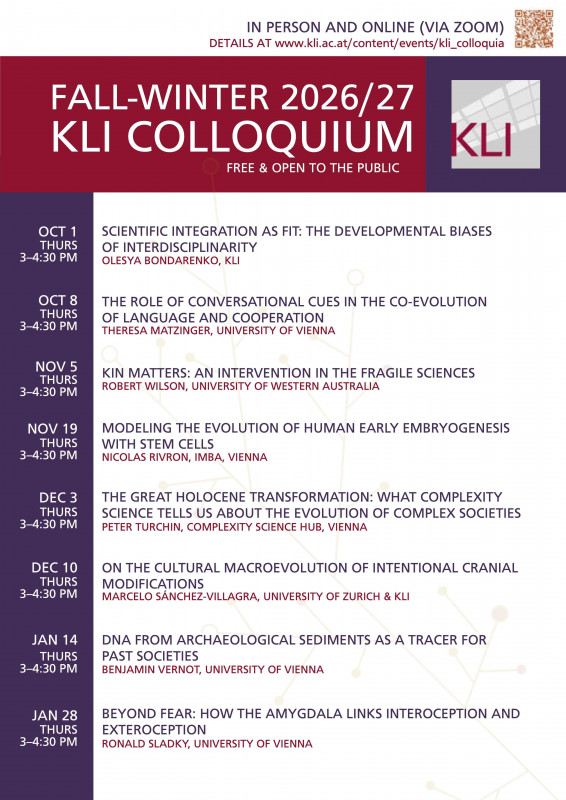
Scientific Integration as Fit: The Developmental Biases of Interdisciplinarity
Olesya BONDARENKO (KLI)
8 October 2026 (Thurs) 3-4:30 PM CET
The Role of Conversational Cues in the Co-Evolution of Language and Cooperation
Theresa MATZINGER (University of Vienna)
5 November 2026 (Thurs) 3-4:30 PM CET
Kin Matters: An Intervention in the Fragile Sciences
Robert A. WILSON (University of Western Australia)
19 November 2026 (Thurs) 3-4:30 PM CET
Modeling the Evolution of Human Early Embryogenesis with Stem Cells
Nicolas RIVRON (Institute of Molecular Biotechnology/IMBA, Vienna)
3 December 2026 (Thurs) 3-4:30 PM CET
Peter TURCHIN (Complexity Science Hub, Vienna)
10 December 2026 (Thurs) 3-4:30 PM CET
On the Cultural Macroevolution of Intentional Cranial Modifications
Marcelo SÁNCHEZ-VILLAGRA (University of Zurich)
14 January 2027 (Thurs) 3-4:30 PM CET
DNA from Archaeological Sediments as a Tracer for Past Societies
Benjamin VERNOT (University of Vienna)
28 January 2027 (Thurs) 3-4:30 PM CET
Beyond Fear: How the Amygdala Links Interoception and Exteroception
Ronald SLADKY (University of Vienna)
KLI Colloquia 2014 – 2026
Event Details
Topic description:
Cultural evolutionists typically emphasize the informational aspect of social transmission, that of the learning, stabilizing, and transformation of mental representations along cultural lineages. Social transmission also depends on the production of public displays such as utterances, behaviors, and artifacts, as these displays are what social learners learn from. However, the generative processes involved in the production of public displays are usually abstracted away in both theoretical assessments and formal models. The aim of the talk is to complement the informational view with a generative dimension, emphasizing how the production of public displays both enable and constrain the production of modular cultural recipes through the process of innovation by recombination. In order to avoid a circular understanding of cultural recombination and cultural modularity, we need to take seriously the nature and structure of the generative processes involved in the maintenance of cultural traditions. I offer a preliminary analysis of what recombination and modularity consist of and show how their study depends on a finer understanding of the generative processes involved in the production phase of social transmission. I argue that the recombination process depends on the inventive production of an interface between modules and the complex recipes in which they figure, and that such interfaces are the direct result of the generative processes involved in the production of the recipes. The analysis is supported by the case study of the transition from the Oldowan to the Early Acheulean flake detachment techniques.
Biographical note:
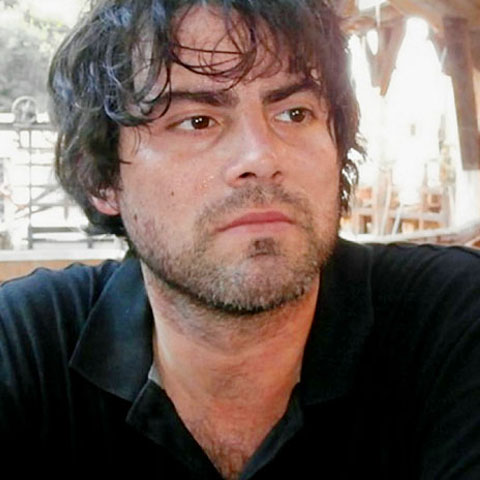
Mathieu Charbonneau completed his PhD in philosophy of science and of biology at the Université de Montréal (2013). The dissertation examined the use of analogical reasoning as a means to transfer theories and explanatory frameworks between scientific disciplines, using as a case study the analogy between genetic inheritance and social learning. He completed a two-years (2013-2015) postdoctoral fellowship at the KLI Institute, researching on the developmental basis of cultural evolution. He is currently a postdoctoral fellow at the Science Studies Program at the Central European University (CEU), in Budapest, working on distributed cognition in science and the impact of novel technologies on scientific change, particularly in paleoarchaeology.
