

KLI Colloquia are invited research talks of about an hour followed by 30 min discussion. The talks are held in English, open to the public, and offered in hybrid format.
Join via Zoom:
https://us02web.zoom.us/j/5881861923?omn=85945744831
Meeting ID: 588 186 1923
Fall-Winter 2026/27 KLI Colloquium Series
1 October 2026 (Thurs) 3-4:30 PM CET 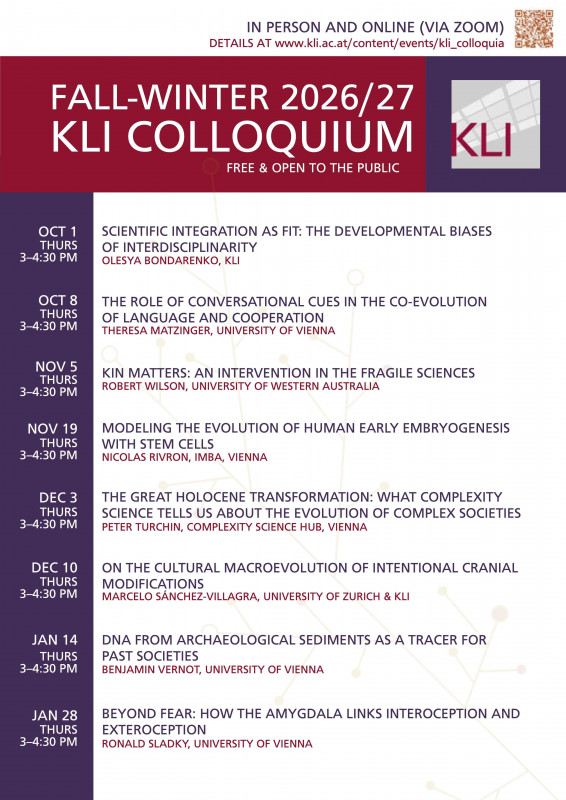
Scientific Integration as Fit: The Developmental Biases of Interdisciplinarity
Olesya BONDARENKO (KLI)
8 October 2026 (Thurs) 3-4:30 PM CET
The Role of Conversational Cues in the Co-Evolution of Language and Cooperation
Theresa MATZINGER (University of Vienna)
5 November 2026 (Thurs) 3-4:30 PM CET
Kin Matters: An Intervention in the Fragile Sciences
Robert A. WILSON (University of Western Australia)
19 November 2026 (Thurs) 3-4:30 PM CET
Modeling the Evolution of Human Early Embryogenesis with Stem Cells
Nicolas RIVRON (Institute of Molecular Biotechnology/IMBA, Vienna)
3 December 2026 (Thurs) 3-4:30 PM CET
Peter TURCHIN (Complexity Science Hub, Vienna)
10 December 2026 (Thurs) 3-4:30 PM CET
On the Cultural Macroevolution of Intentional Cranial Modifications
Marcelo SÁNCHEZ-VILLAGRA (University of Zurich)
14 January 2027 (Thurs) 3-4:30 PM CET
DNA from Archaeological Sediments as a Tracer for Past Societies
Benjamin VERNOT (University of Vienna)
28 January 2027 (Thurs) 3-4:30 PM CET
Beyond Fear: How the Amygdala Links Interoception and Exteroception
Ronald SLADKY (University of Vienna)
KLI Colloquia 2014 – 2026
Event Details

Topic description:
In this talk, I will briefly introduce the framework of information theory as applied to biological signaling networks. Known under the name of “efficient coding”, this framework has been able to quantitatively explain various (nontrivial) properties of neural processing from first principles. In this regard, applications of efficient coding represent true “ab initio” predictions, rather than fits of specific mathematical models to data. I will then present our attempts to build a similarly predictive theory for genetic regulatory networks, along with a specific application to the gap gene network in the fruit fly. I will conclude with a few thoughts on why information transmission through signaling networks might be implicitly selected for during evolutionary adaptation.
Biographical note:
Gasper Tkacik joined IST Austria in 2011 as an Assistant Professor. Previously, he was a postdoc with Vijay Balasubramanian and Phil Nelson at University of Pennsylvania, working on the theory of neural coding and specifically exploring population coding and adaptation in the retina. He finished his PhD in Physics at Princeton with Bill Bialek and Curt Callan in 2007, studying how biological networks can reliably transmit and process information in the presence of intrinsic noise and corrupted signals. He is broadly interested in uncovering general principles that underlie efficient biological computation. He works both on data-driven and purely theoretical problems, and combines approaches from statistical physics, information theory, and machine learning.
