
KLI Colloquia are invited research talks of about an hour followed by 30 min discussion. The talks are held in English, open to the public, and offered in hybrid format.
Join via Zoom:
https://us02web.zoom.us/j/5881861923?omn=85945744831
Meeting ID: 588 186 1923
Fall-Winter 2026/27 KLI Colloquium Series
1 October 2026 (Thurs) 3-4:30 PM CET 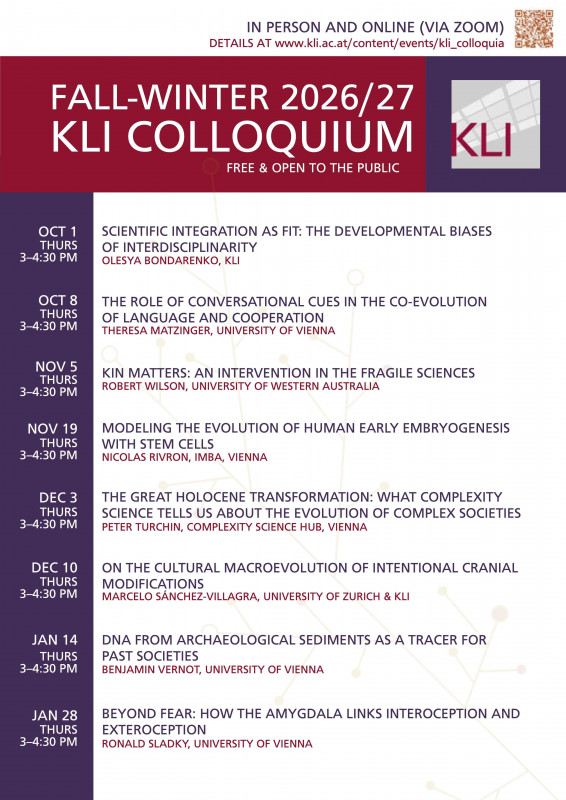
Scientific Integration as Fit: The Developmental Biases of Interdisciplinarity
Olesya BONDARENKO (KLI)
8 October 2026 (Thurs) 3-4:30 PM CET
The Role of Conversational Cues in the Co-Evolution of Language and Cooperation
Theresa MATZINGER (University of Vienna)
5 November 2026 (Thurs) 3-4:30 PM CET
Kin Matters: An Intervention in the Fragile Sciences
Robert A. WILSON (University of Western Australia)
19 November 2026 (Thurs) 3-4:30 PM CET
Modeling the Evolution of Human Early Embryogenesis with Stem Cells
Nicolas RIVRON (Institute of Molecular Biotechnology/IMBA, Vienna)
3 December 2026 (Thurs) 3-4:30 PM CET
Peter TURCHIN (Complexity Science Hub, Vienna)
10 December 2026 (Thurs) 3-4:30 PM CET
On the Cultural Macroevolution of Intentional Cranial Modifications
Marcelo SÁNCHEZ-VILLAGRA (University of Zurich)
14 January 2027 (Thurs) 3-4:30 PM CET
DNA from Archaeological Sediments as a Tracer for Past Societies
Benjamin VERNOT (University of Vienna)
28 January 2027 (Thurs) 3-4:30 PM CET
Beyond Fear: How the Amygdala Links Interoception and Exteroception
Ronald SLADKY (University of Vienna)
KLI Colloquia 2014 – 2026
Event Details
Join Zoom Meeting
https://us02web.zoom.us/j/5881861923?omn=85945744831
Meeting ID: 588 186 1923
Topic description / abstract
Recent years have seen the growth of work illuminating the mechanical aspects of morphogenesis, but its relationship to the established ideas and evidence of developmental and evolutionary genetics remains unclear. This talk examines the conceptual relationship between mechanics and genetics in the context of animal morphogenesis. I propose a view in which ‘genetic programs’—understood as gene regulatory networks—and processes of physical self-organization are not conflicting models of development, but instead play necessary and complementary causal roles at cellular and supra-cellular length scales, respectively. On this basis, I describe differences in how mechanical versus genetic factors influence the evolvability of morphological traits.
Biographical note
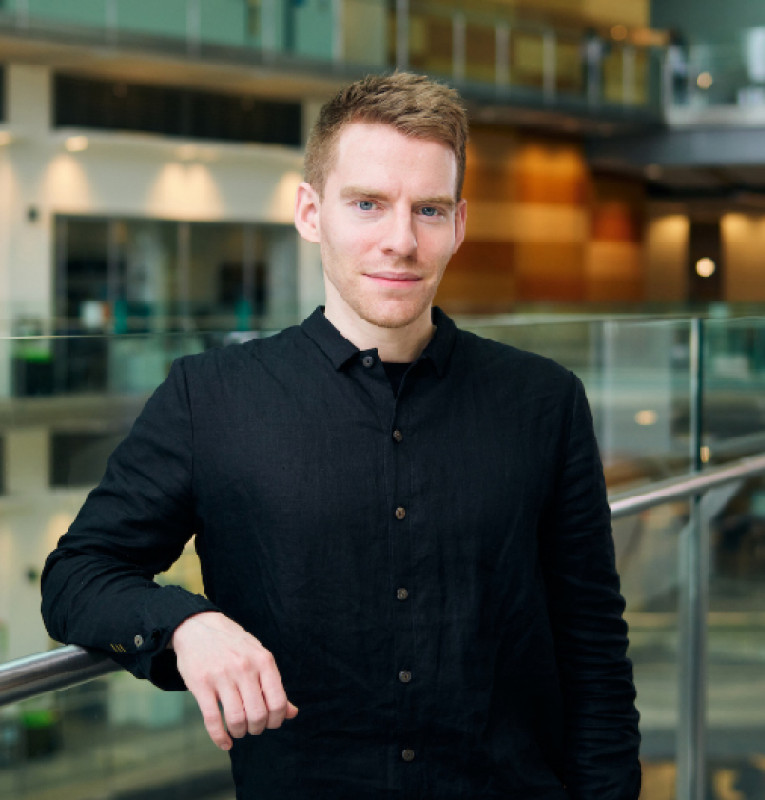
James DiFrisco is a group leader and head of the theoretical biology lab at the Francis Crick Institute. Having trained in philosophy of science during his PhD, his research developed a focus on conceptual and theoretical issues in evolutionary-developmental biology and systems biology. He previously held postdoctoral positions at the Konrad Lorenz Institute (2015-2018) and KU Leuven (2018-2023) before joining the Crick in 2023. Current research interests include: comparative biology of vertebrate gastrulation, evolution of pleiotropy, body size and biophysical scaling, and evolutionary mechanobiology.
