

KLI Colloquia are invited research talks of about an hour followed by 30 min discussion. The talks are held in English, open to the public, and offered in hybrid format.
Join via Zoom:
https://us02web.zoom.us/j/5881861923?omn=85945744831
Meeting ID: 588 186 1923
Fall-Winter 2026/27 KLI Colloquium Series
1 October 2026 (Thurs) 3-4:30 PM CET 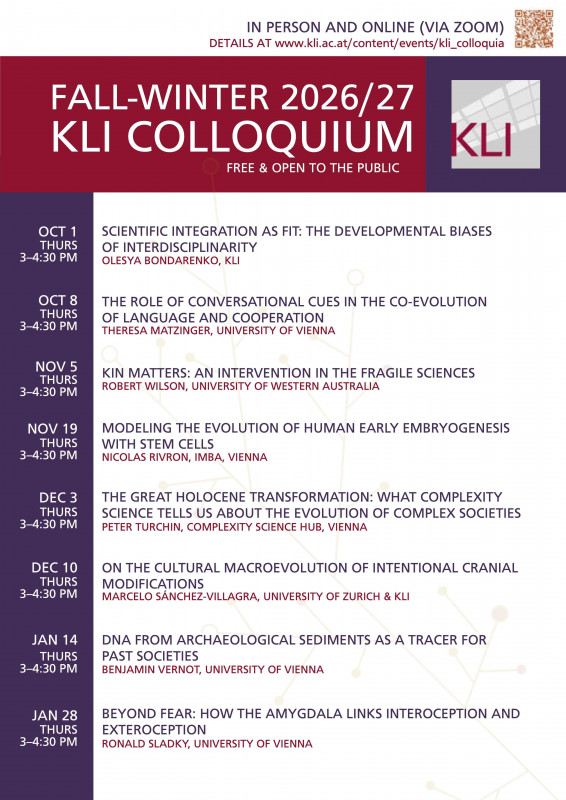
Scientific Integration as Fit: The Developmental Biases of Interdisciplinarity
Olesya BONDARENKO (KLI)
8 October 2026 (Thurs) 3-4:30 PM CET
The Role of Conversational Cues in the Co-Evolution of Language and Cooperation
Theresa MATZINGER (University of Vienna)
5 November 2026 (Thurs) 3-4:30 PM CET
Kin Matters: An Intervention in the Fragile Sciences
Robert A. WILSON (University of Western Australia)
19 November 2026 (Thurs) 3-4:30 PM CET
Modeling the Evolution of Human Early Embryogenesis with Stem Cells
Nicolas RIVRON (Institute of Molecular Biotechnology/IMBA, Vienna)
3 December 2026 (Thurs) 3-4:30 PM CET
Peter TURCHIN (Complexity Science Hub, Vienna)
10 December 2026 (Thurs) 3-4:30 PM CET
On the Cultural Macroevolution of Intentional Cranial Modifications
Marcelo SÁNCHEZ-VILLAGRA (University of Zurich)
14 January 2027 (Thurs) 3-4:30 PM CET
DNA from Archaeological Sediments as a Tracer for Past Societies
Benjamin VERNOT (University of Vienna)
28 January 2027 (Thurs) 3-4:30 PM CET
Beyond Fear: How the Amygdala Links Interoception and Exteroception
Ronald SLADKY (University of Vienna)
KLI Colloquia 2014 – 2026
Event Details
Join via Zoom:
https://us02web.zoom.us/j/5881861923?omn=85945744831
Meeting ID: 588 186 1923
Topic description / abstract:
Could a brainless biological entity be conscious? These and other mind/body modal claims – involving modal concepts of possibilty, necessity, and counterfactuality – have long been interpreted in terms of logical or physical possibility. Yet to bring new biological and psychological knowledge to bear on our assessments of their truth, such claims must be reinterpreted in terms of biological modality. In this talk I will introduce the problem of interpreting mind/body modal claims, the nature of biological modality, and the impact of reinterpreting these claims in terms of biological modality on future empirical research and current debates about mind/body problems, including the possibility of conscious artificial devices.
Biographical note:
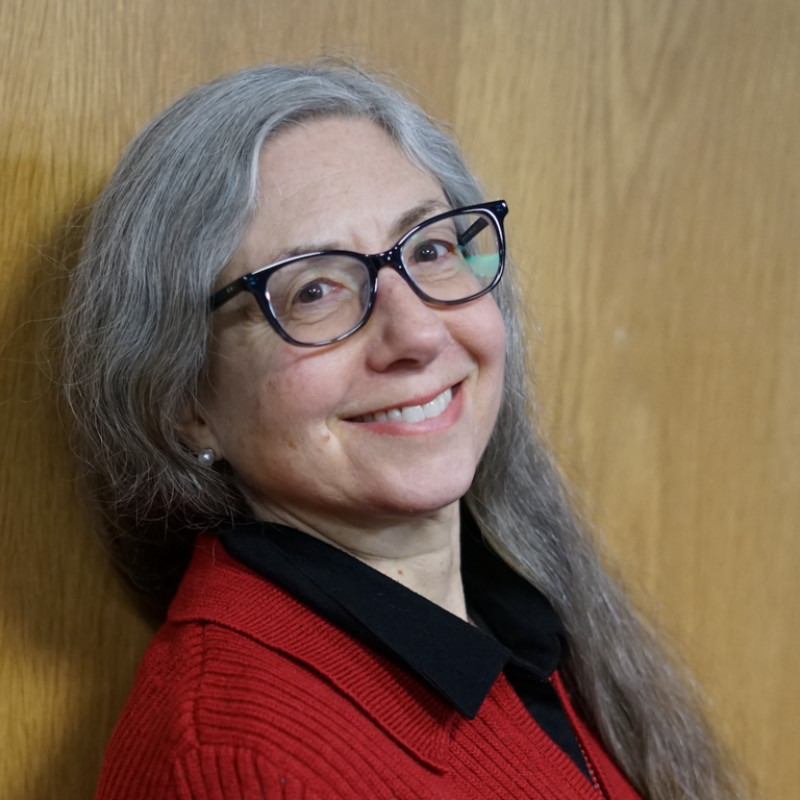
Carrie Figdor is a professor of philosophy at the University of Iowa and an honorary professor of philosophy at the University of Edinburgh. Her main research involves developing the philosophical foundations of psychology within a phylogenetic conceptual framework. Her 2018 book, Pieces of Mind: the proper domain of psychological predicates (OUP) won an Honorable Mention for the 2019 APA Marc Sanders Book Prize, and her papers have appeared in Philosophy of Science, The Journal of Philosophy, Behavioral and Brain Sciences, Brains, Behavior and Evolution, Mind & Language, Philosophical Studies, and other leading journals.
