
KLI Colloquia are invited research talks of about an hour followed by 30 min discussion. The talks are held in English, open to the public, and offered in hybrid format.
Join via Zoom:
https://us02web.zoom.us/j/5881861923?omn=85945744831
Meeting ID: 588 186 1923
Fall-Winter 2026/27 KLI Colloquium Series
1 October 2026 (Thurs) 3-4:30 PM CET 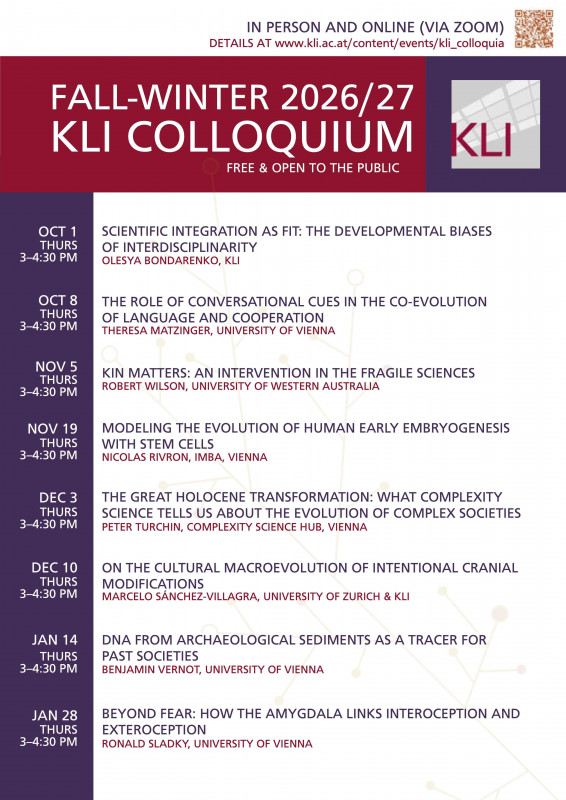
Scientific Integration as Fit: The Developmental Biases of Interdisciplinarity
Olesya BONDARENKO (KLI)
8 October 2026 (Thurs) 3-4:30 PM CET
The Role of Conversational Cues in the Co-Evolution of Language and Cooperation
Theresa MATZINGER (University of Vienna)
5 November 2026 (Thurs) 3-4:30 PM CET
Kin Matters: An Intervention in the Fragile Sciences
Robert A. WILSON (University of Western Australia)
19 November 2026 (Thurs) 3-4:30 PM CET
Modeling the Evolution of Human Early Embryogenesis with Stem Cells
Nicolas RIVRON (Institute of Molecular Biotechnology/IMBA, Vienna)
3 December 2026 (Thurs) 3-4:30 PM CET
Peter TURCHIN (Complexity Science Hub, Vienna)
10 December 2026 (Thurs) 3-4:30 PM CET
On the Cultural Macroevolution of Intentional Cranial Modifications
Marcelo SÁNCHEZ-VILLAGRA (University of Zurich)
14 January 2027 (Thurs) 3-4:30 PM CET
DNA from Archaeological Sediments as a Tracer for Past Societies
Benjamin VERNOT (University of Vienna)
28 January 2027 (Thurs) 3-4:30 PM CET
Beyond Fear: How the Amygdala Links Interoception and Exteroception
Ronald SLADKY (University of Vienna)
KLI Colloquia 2014 – 2026
Event Details
You are invited to a Zoom meeting.
When: Jan 11, 2024 03:00 PM Vienna
Register in advance for this meeting:
https://us02web.zoom.us/meeting/register/tZIpc-6rrzgtH9cwq3IkknNHb03Z3waUi4rQ
After registering, you will receive a confirmation email containing information about joining the meeting.
Topic description / abstract:
In the midst of multiple crises, this presentation delves into the theme of knowledge production and integration within Austria's scientific landscape. It underscores the imperative outlined by the Austrian University Act, urging scientists to contribute to societal welfare. The presentation scrutinizes the challenges arising from incomplete and disputed knowledge, compounded by the urgency to act in an environment where trust in science is low. Examples from transdisciplinary research projects will shed light on practical approaches for the co-production and integration of knowledge. The argument presented emphasizes the significance of scientific debates in addressing various gaps within the literature on transdisciplinarity. As trust in science is key—particularly in times of crises, the presentation emphasizes the importance of navigating these challenges with robust research approaches that contribute meaningfully to both scientific and societal problems.
Biographical note:
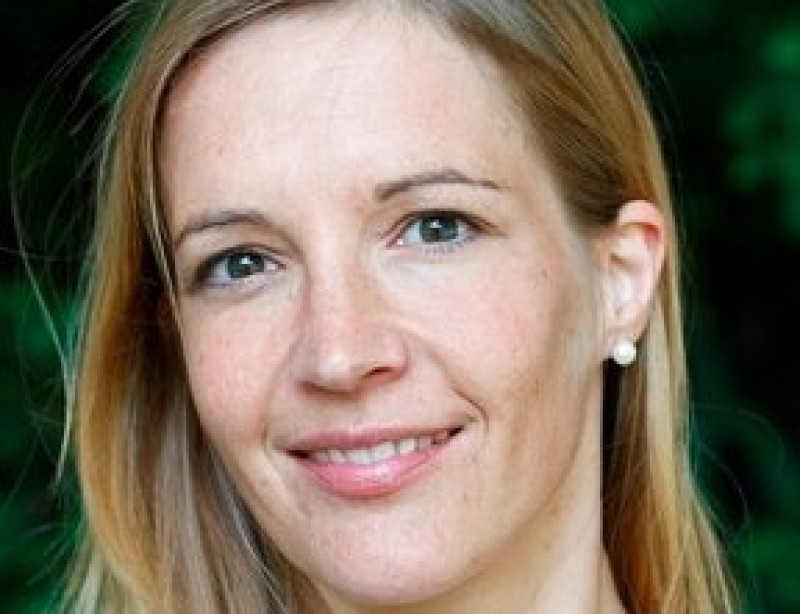
Marianne Penker, a professor of rural sociology and development at the University of Natural Resources and Life Sciences Vienna, is dedicated to sustainability science. Her focus lies in fostering transformative solutions for rural areas in Europe and globally through inter- and transdisciplinary research and teaching.
