
KLI Colloquia are invited research talks of about an hour followed by 30 min discussion. The talks are held in English, open to the public, and offered in hybrid format.
Join via Zoom:
https://us02web.zoom.us/j/5881861923?omn=85945744831
Meeting ID: 588 186 1923
Spring-Summer 2026 KLI Colloquium Series
12 March 2026 (Thurs) 3-4:30 PM CET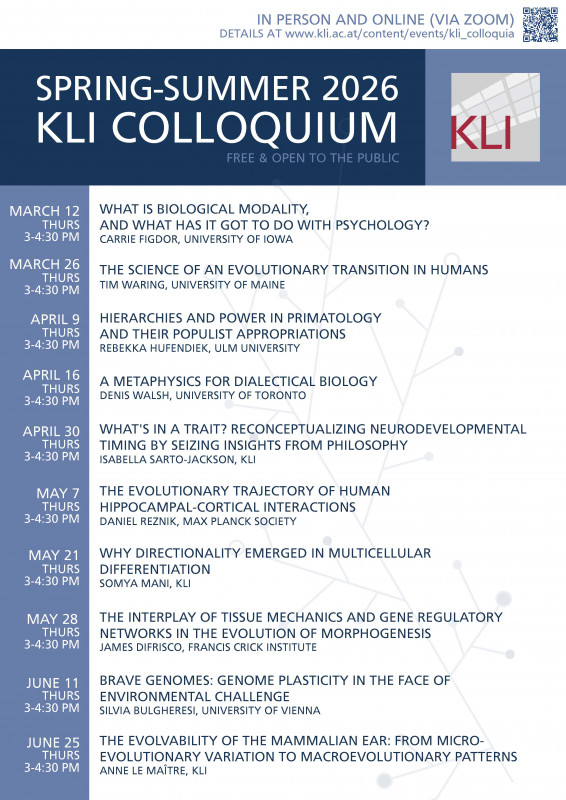
What Is Biological Modality, and What Has It Got to Do With Psychology?
Carrie Figdor (University of Iowa)
26 March 2026 (Thurs) 3-4:30 PM CET
The Science of an Evolutionary Transition in Humans
Tim Waring (University of Maine)
9 April 2026 (Thurs) 3-4:30 PM CET
Hierarchies and Power in Primatology and Their Populist Appropriation
Rebekka Hufendiek (Ulm University)
16 April 2026 (Thurs) 3-4:30 PM CET
A Metaphysics for Dialectical Biology
Denis Walsh (University of Toronto)
30 April 2026 (Thurs) 3-4:30 PM CET
What's in a Trait? Reconceptualizing Neurodevelopmental Timing by Seizing Insights From Philosophy
Isabella Sarto-Jackson (KLI)
7 May 2026 (Thurs) 3-4:30 PM CET
The Evolutionary Trajectory of Human Hippocampal-Cortical Interactions
Daniel Reznik (Max Planck Society)
21 May 2026 (Thurs) 3-4:30 PM CET
Why Directionality Emerged in Multicellular Differentiation
Somya Mani (KLI)
28 May 2026 (Thurs) 3-4:30 PM CET
The Interplay of Tissue Mechanics and Gene Regulatory Networks in the Evolution of Morphogenesis
James DiFrisco (Francis Crick Institute)
11 June 2026 (Thurs) 3-4:30 PM CET
Brave Genomes: Genome Plasticity in the Face of Environmental Challenge
Silvia Bulgheresi (University of Vienna)
25 June 2026 (Thurs) 3-4:30 PM CET
Anne LeMaitre (KLI)
KLI Colloquia 2014 – 2026
Event Details
Objectives
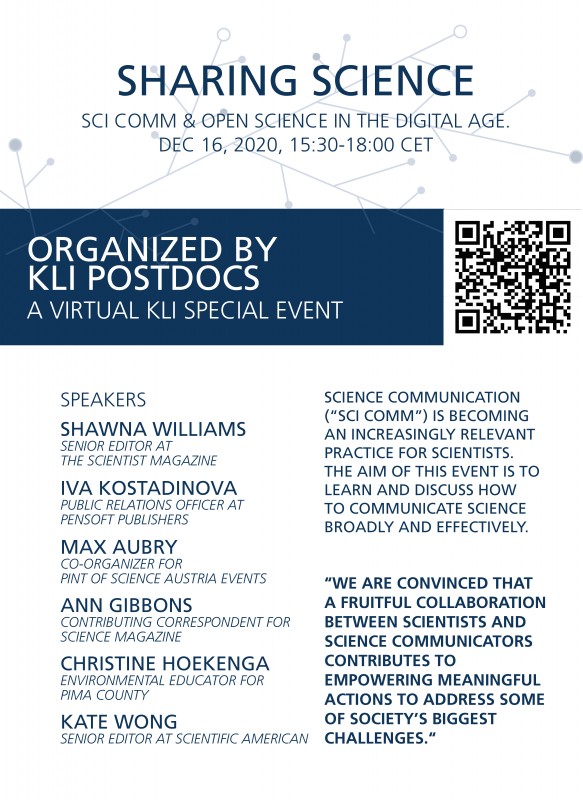
Science communication (“Sci Comm”) is becoming an increasingly relevant practice. Not only does it improve the exchange of information between scientists and the general public, stakeholders, policy makers, and other academics, it also increases the visibility of research programmes. While some decades ago it was mostly carried out by a small number of scientists and science-journalists, Sci Comm is now a growing academic field involving experts coming from different backgrounds.
As a group of early career researchers, we would like to get in contact with expert and career science communicators, with the aim of learning from each other about how to communicate science broadly and effectively. This pertains to choosing an appropriate medium and outlets for science communication and accessing the professional domains of science journalism for knowledge about strategies in promoting one’s research. This assumes that the priority is to establish a dialogue that allows academics and journalists to efficiently work together and to both be satisfied by the outcome. We are convinced that a fruitful collaboration between scientists and science communicators would contribute to empowering meaningful actions to address some of the society’s biggest challenges.
Synopsis
In early 2020, the KLI Fellows self-organized a series of dialogues around Science Communication and Open Science (open-access publishing and data sharing). The practical knowledge of how one can and should communicate their academic work, and the perspectives about whether such work can be published without monetary barriers, is a central issue in the career life of those in the academy. Therefore, as early-career postdocs, facing the daunting task of speaking to the academic or scientific public at large, we want to bring together science communication experts who can share their knowledge and experience about what it takes to be effective communicators of science through short presentations and discussion. We aim to carry out these dialogues over multiple sessions in the coming months between December 2020 and the Spring of 2021.
The first session will be focused on Sci Comm. Since Sci Comm is a wide bracket that can encompass many types of activities created by and directed at diverse communities (e.g. scientists to scientists; scientists to public; scientists to journalists; etc.), our intent for this dialogue is to hear directly from Sci Comm professionals that specialize in producing and editing scientific content for a broad audience.
The Sci Comm session will take place on the 16th December as a closed-door event via Zoom. We have lined up a panel of six invited speakers who are active communicators of science:
Speakers
- Max Aubry (Austria) - Co-organizer for Pint of Science Austria events.
- Ann Gibbons (USA) - Contributing Correspondent for Science magazine
- Christine Hoekenga (USA) - Environmental educator for Pima County
- Iva Kostadinova (Bulgaria) - Public Relations Officer at Pensoft Publishers
- Shawna Williams (USA) - Senior Editor at The Scientist Magazine
- Kate Wong (USA) - Senior Editor at Scientific American
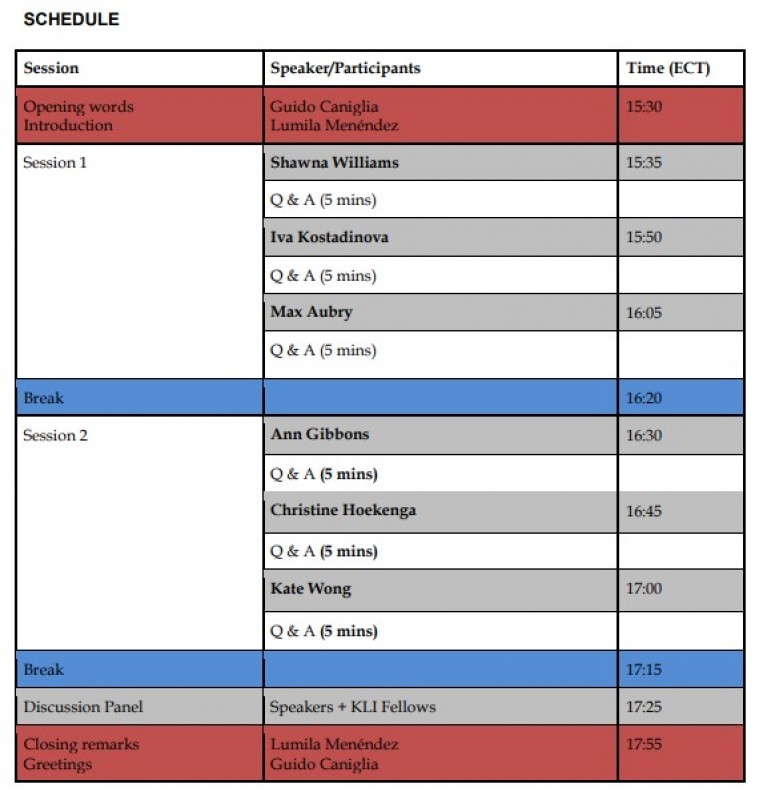
Program
Organizers
Lumila Menéndez
Nicole Grunstra
Alice Laciny
Stephanie Schnorr
Christian Dorninger
Orsolya Bajer-Molnár
Flavia Fabris
Marco Vianna Franco
Luana Poliseli
Roberto Cazzolla Gatti
