
KLI Colloquia are invited research talks of about an hour followed by 30 min discussion. The talks are held in English, open to the public, and offered in hybrid format.
Join via Zoom:
https://us02web.zoom.us/j/5881861923?omn=85945744831
Meeting ID: 588 186 1923
Spring-Summer 2026 KLI Colloquium Series
12 March 2026 (Thurs) 3-4:30 PM CET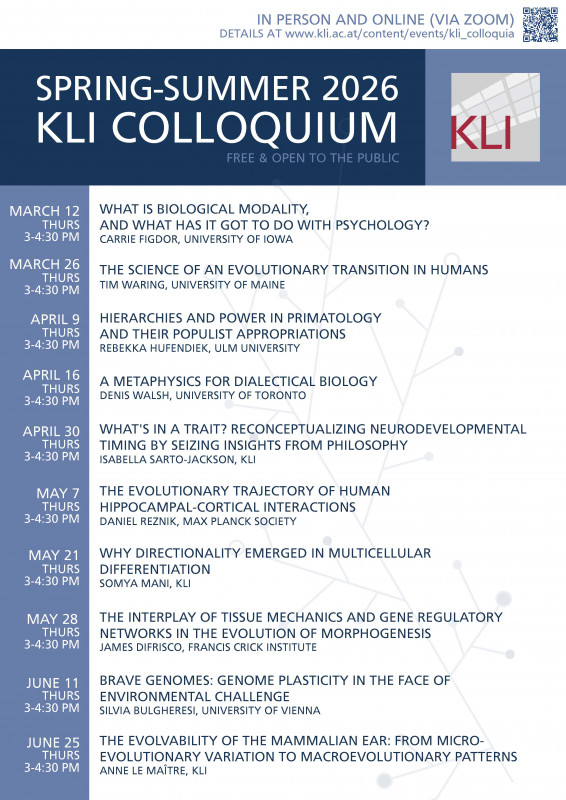
What Is Biological Modality, and What Has It Got to Do With Psychology?
Carrie Figdor (University of Iowa)
26 March 2026 (Thurs) 3-4:30 PM CET
The Science of an Evolutionary Transition in Humans
Tim Waring (University of Maine)
9 April 2026 (Thurs) 3-4:30 PM CET
Hierarchies and Power in Primatology and Their Populist Appropriation
Rebekka Hufendiek (Ulm University)
16 April 2026 (Thurs) 3-4:30 PM CET
A Metaphysics for Dialectical Biology
Denis Walsh (University of Toronto)
30 April 2026 (Thurs) 3-4:30 PM CET
What's in a Trait? Reconceptualizing Neurodevelopmental Timing by Seizing Insights From Philosophy
Isabella Sarto-Jackson (KLI)
7 May 2026 (Thurs) 3-4:30 PM CET
The Evolutionary Trajectory of Human Hippocampal-Cortical Interactions
Daniel Reznik (Max Planck Society)
21 May 2026 (Thurs) 3-4:30 PM CET
Why Directionality Emerged in Multicellular Differentiation
Somya Mani (KLI)
28 May 2026 (Thurs) 3-4:30 PM CET
The Interplay of Tissue Mechanics and Gene Regulatory Networks in the Evolution of Morphogenesis
James DiFrisco (Francis Crick Institute)
11 June 2026 (Thurs) 3-4:30 PM CET
Brave Genomes: Genome Plasticity in the Face of Environmental Challenge
Silvia Bulgheresi (University of Vienna)
25 June 2026 (Thurs) 3-4:30 PM CET
Anne LeMaitre (KLI)
KLI Colloquia 2014 – 2026
Event Details

Topic description / abstract:
My project examines a major epistemic and imaginative technique through which North Atlantic
institutions now perceive and govern the turbulent globe as a totality: “scenario planning.” Scenario
planning is a central method of post-statistical futurology, premised on imaginative narrative rather than
the extrapolation of probable trends. Developed by multinational oil companies during the energy crises
of the 1970s, and later adopted as a tool for the governance of the planetary environment amidst global
warming, scenario planning is today a central method of foreknowledge through which North Atlantic
states, corporations, and institutions of international governance systematically envision the plausible
futures of the planet, and the possibilities and consequences of their own actions within those futures.
Beginning from the anthropological premise that such techniques of anticipatory knowledge are not
value-neutral tools but historically and culturally specific genres for envisioning and ordering collective
existence, my project asks how scenario planning enframes the politics of planetary sustainability today.
My research will explore the logic of global-scale scenario planning through examination of two critical
cases: (1) its cultivation at Royal Dutch Shell in the 1970s, under the influence of cybernetic theory and
global decolonization, and (2) its contemporary deployment in the making of the Assessment Reports of
the Intergovernmental Panel on Climate Change. By examining the work of scenario planners through
archival and ethnographic research, I mean to elucidate the political significance of the epistemological
and imaginative techniques that underpin global sustainability governance in a warming and unequal
world.
Biographical note:
Cameron Hu holds a PhD in anthropology from the University of Chicago. His research explores the political-economic and techno-scientific logics that shape the global frontier in "unconventional" oil extraction.
