

KLI Colloquia are invited research talks of about an hour followed by 30 min discussion. The talks are held in English, open to the public, and offered in hybrid format.
Join via Zoom:
https://us02web.zoom.us/j/5881861923?omn=85945744831
Meeting ID: 588 186 1923
Spring-Summer 2026 KLI Colloquium Series
12 March 2026 (Thurs) 3-4:30 PM CET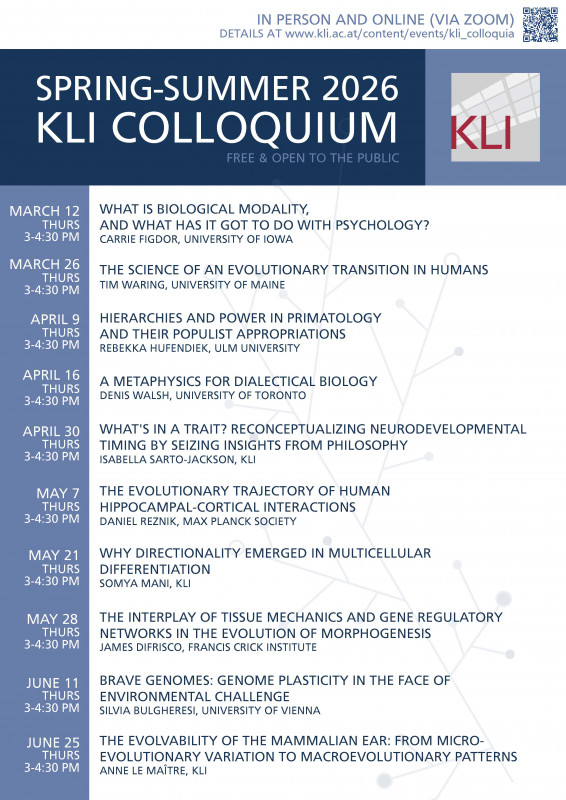
What Is Biological Modality, and What Has It Got to Do With Psychology?
Carrie Figdor (University of Iowa)
26 March 2026 (Thurs) 3-4:30 PM CET
The Science of an Evolutionary Transition in Humans
Tim Waring (University of Maine)
9 April 2026 (Thurs) 3-4:30 PM CET
Hierarchies and Power in Primatology and Their Populist Appropriation
Rebekka Hufendiek (Ulm University)
16 April 2026 (Thurs) 3-4:30 PM CET
A Metaphysics for Dialectical Biology
Denis Walsh (University of Toronto)
30 April 2026 (Thurs) 3-4:30 PM CET
What's in a Trait? Reconceptualizing Neurodevelopmental Timing by Seizing Insights From Philosophy
Isabella Sarto-Jackson (KLI)
7 May 2026 (Thurs) 3-4:30 PM CET
The Evolutionary Trajectory of Human Hippocampal-Cortical Interactions
Daniel Reznik (Max Planck Society)
21 May 2026 (Thurs) 3-4:30 PM CET
Why Directionality Emerged in Multicellular Differentiation
Somya Mani (KLI)
28 May 2026 (Thurs) 3-4:30 PM CET
The Interplay of Tissue Mechanics and Gene Regulatory Networks in the Evolution of Morphogenesis
James DiFrisco (Francis Crick Institute)
11 June 2026 (Thurs) 3-4:30 PM CET
Brave Genomes: Genome Plasticity in the Face of Environmental Challenge
Silvia Bulgheresi (University of Vienna)
25 June 2026 (Thurs) 3-4:30 PM CET
Anne LeMaitre (KLI)
KLI Colloquia 2014 – 2026
Event Details

Zoom link for registration:
Deadline for the registration with Zoom is 3 pm on the day of the talk.
Please take note that nobody will be admitted in the room after 5:05 pm.
Topic description / abstract:
The income gap between the global North and South has increased dramatically since the end of colonialism. Why is this happening? What is driving this divergence? And how does global inequality play out in ecological terms? By identifying the structural determinants of inequality, we can find effective ways to address it. But ultimately the solution requires that the high-income nations of the global North abandon economic growth as a political objective and shift to post-growth models, in order to actively scale down their use of resources and energy.
Biographical note:
Dr. Jason Hickel is an economic anthropologist, author, and a Fellow of the Royal Society of Arts. He is a Senior Lecturer at Goldsmiths, University of London. He serves on the Statistical Advisory Panel for the UN Human Development Report 2020, the advisory board of the Green New Deal for Europe, and on the Harvard-Lancet Commission on Reparations and Redistributive Justice.
Jason's research focuses on global inequality, political economy, post-development, and ecological economics, which are the subjects of his two most recent books: The Divide: A Brief Guide to Global Inequality and its Solutions (Penguin, 2017), and Less is More: How Degrowth Will Save the World (Penguin, 2020).
Jason's ethnographic work focuses on migrant labour and politics in South Africa, which is the subject of his first book, Democracy as Death: The Moral Order of Anti-Liberal Politics in South Africa (University of California Press, 2015). He is co-editor of two additional ethnographic volumes: Ekhaya: The Politics of Home in KwaZulu-Natal (University of KwaZulu-Natal Press, 2014) and Hierarchy and Value: Comparative Perspectives on Moral Order (Berghahn, 2018).
In addition to his academic work, Jason writes regularly for The Guardian and Foreign Policy, and contributes to a number of other online outlets including Al Jazeera, Fast Company, Prospect, Jacobin, Le Monde Diplomatique, New Internationalist, Red Pepper, Truthout, and Monthly Review. His media appearances include Viewsnight, the Financial Times, the BBC World Service, Sky News All Out Politics, BBC Business Matters, Thinking Allowed, Renegade TV, NPR, Doha Debates, TRT World, the LA Times, Citations Needed, and Russell Brand's podcast Under the Skin.
Jason has received a number of teaching awards, including the ASA/HEA National Award for Excellence in Teaching Anthropology. His research has been funded by Fulbright-Hays, the National Science Foundation, the Wenner-Gren Foundation, the Charlotte W. Newcombe Foundation, and the Leverhulme Trust.
He is originally from Swaziland.
