

KLI Colloquia are invited research talks of about an hour followed by 30 min discussion. The talks are held in English, open to the public, and offered in hybrid format.
Join via Zoom:
https://us02web.zoom.us/j/5881861923?omn=85945744831
Meeting ID: 588 186 1923
Fall-Winter 2026/27 KLI Colloquium Series
1 October 2026 (Thurs) 3-4:30 PM CET 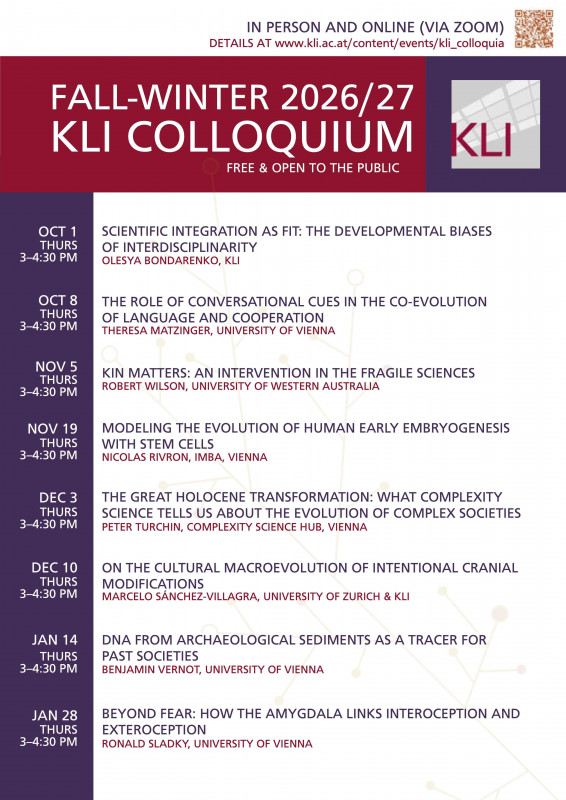
Scientific Integration as Fit: The Developmental Biases of Interdisciplinarity
Olesya BONDARENKO (KLI)
8 October 2026 (Thurs) 3-4:30 PM CET
The Role of Conversational Cues in the Co-Evolution of Language and Cooperation
Theresa MATZINGER (University of Vienna)
5 November 2026 (Thurs) 3-4:30 PM CET
Kin Matters: An Intervention in the Fragile Sciences
Robert A. WILSON (University of Western Australia)
19 November 2026 (Thurs) 3-4:30 PM CET
Modeling the Evolution of Human Early Embryogenesis with Stem Cells
Nicolas RIVRON (Institute of Molecular Biotechnology/IMBA, Vienna)
3 December 2026 (Thurs) 3-4:30 PM CET
Peter TURCHIN (Complexity Science Hub, Vienna)
10 December 2026 (Thurs) 3-4:30 PM CET
On the Cultural Macroevolution of Intentional Cranial Modifications
Marcelo SÁNCHEZ-VILLAGRA (University of Zurich)
14 January 2027 (Thurs) 3-4:30 PM CET
DNA from Archaeological Sediments as a Tracer for Past Societies
Benjamin VERNOT (University of Vienna)
28 January 2027 (Thurs) 3-4:30 PM CET
Beyond Fear: How the Amygdala Links Interoception and Exteroception
Ronald SLADKY (University of Vienna)
KLI Colloquia 2014 – 2026
Event Details
Zoom link for registration:
Deadline for the registration with Zoom is 3 pm on the day of the talk.
Please take note that nobody will be admitted in the room after 5:05 pm.
Topic description / abstract:
Ant colonies can harbor diverse parasites and pathogens, many of which are known to induce phenotypic changes in their hosts. Although hitherto largely overlooked in the context of ecological evolutionary developmental biology (eco-evo-devo), the study of parasitogenic morphologies can shed light on mechanisms and pathways relevant to the ontogenetic development of the host, their plasticity or robustness under environmental perturbations, as well as caste evolution and ecological consequences for the host and its colony.
As a postdoctoral fellow at the KLI, I am assessing the extant body of scientific literature regarding parasite-induced morphological changes in ants. Therein, I compare previously described host-parasite systems and assess commonalities and differences of parasitogenic phenotypes and their underlying developmental mechanisms, their relevance to the eco-evo-devo framework, as well as persistent knowledge-gaps and suitable systems for further studies. Furthermore, I hope to contribute a critical evaluation of current methods and biases in ant-parasite research, and provide access to hitherto hidden gems from historical German literature on the subject. This will contribute towards highlighting the importance of parasites of social insects for both biological theory and empirical research.
This current research colloquium will represent an introduction into the broad topic of ants and their parasites, give an overview of the ongoing research, and highlight aspects of particular interest by presenting selected examples from the diverse range of host-parasite systems treated within the project.
Biographical note:
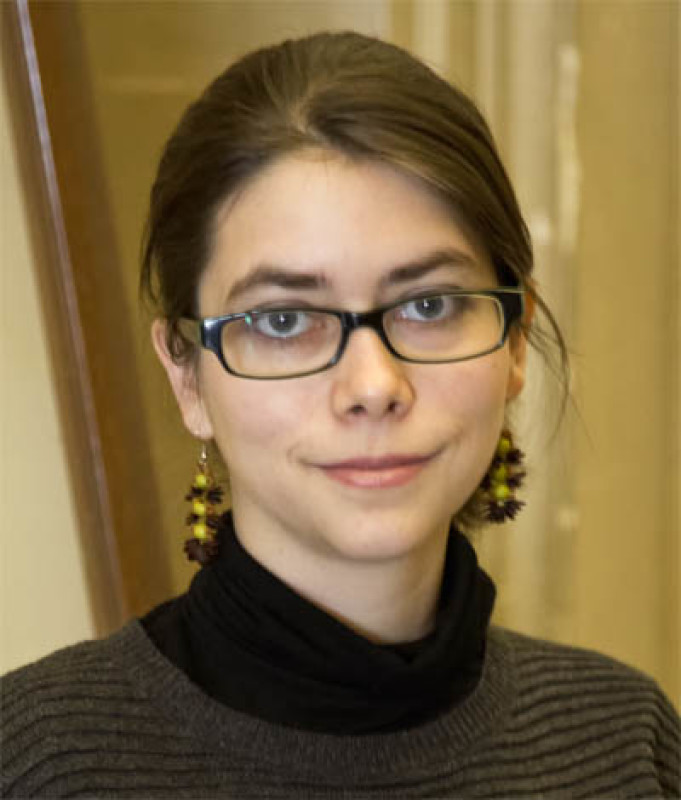
Alice Laciny is a former PhD student at the Department of Theoretical Biology at the University of Vienna and in early 2019 completed her thesis in the course of the WWTF project “Voluntary self-sacrifice in exploding ants: a mechanism to defend coevolved microbiomes?” at the Natural History Museum Vienna. She has been fascinated by insects from an early age and became president of the Austrian Entomologists' Association in 2017. Her scientific interests include myrmecology, parasitology, evolutionary developmental biology, caste-characterization of social insects via morphological, statistical, and behavioural methods, as well as science communication and editorial work. Her postdoctoral research now focusses on the influence of parasites on the morphology of ant hosts. Her current project at the KLI aims to review the body of current literature on this topic and highlight the overlapping aspects of ecology, evolution and ontogenetic development therein.
