

KLI Colloquia are invited research talks of about an hour followed by 30 min discussion. The talks are held in English, open to the public, and offered in hybrid format.
Join via Zoom:
https://us02web.zoom.us/j/5881861923?omn=85945744831
Meeting ID: 588 186 1923
Fall-Winter 2026/27 KLI Colloquium Series
1 October 2026 (Thurs) 3-4:30 PM CET 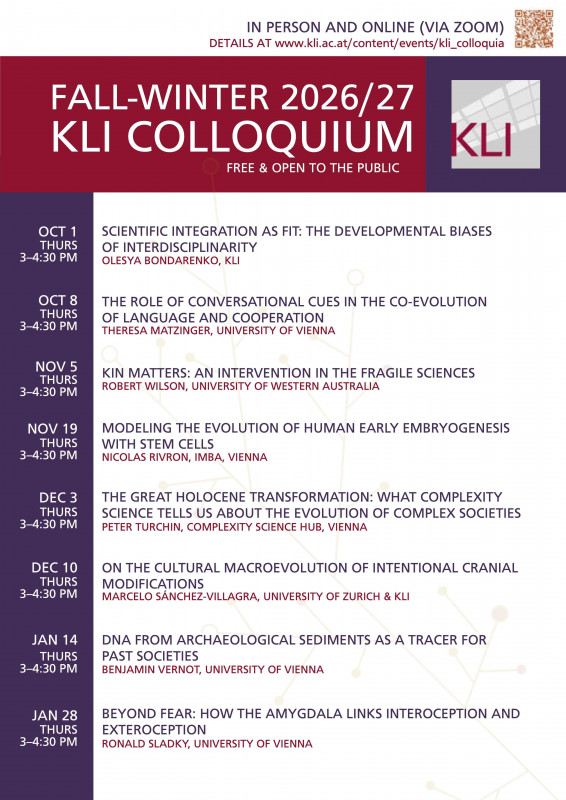
Scientific Integration as Fit: The Developmental Biases of Interdisciplinarity
Olesya BONDARENKO (KLI)
8 October 2026 (Thurs) 3-4:30 PM CET
The Role of Conversational Cues in the Co-Evolution of Language and Cooperation
Theresa MATZINGER (University of Vienna)
5 November 2026 (Thurs) 3-4:30 PM CET
Kin Matters: An Intervention in the Fragile Sciences
Robert A. WILSON (University of Western Australia)
19 November 2026 (Thurs) 3-4:30 PM CET
Modeling the Evolution of Human Early Embryogenesis with Stem Cells
Nicolas RIVRON (Institute of Molecular Biotechnology/IMBA, Vienna)
3 December 2026 (Thurs) 3-4:30 PM CET
Peter TURCHIN (Complexity Science Hub, Vienna)
10 December 2026 (Thurs) 3-4:30 PM CET
On the Cultural Macroevolution of Intentional Cranial Modifications
Marcelo SÁNCHEZ-VILLAGRA (University of Zurich)
14 January 2027 (Thurs) 3-4:30 PM CET
DNA from Archaeological Sediments as a Tracer for Past Societies
Benjamin VERNOT (University of Vienna)
28 January 2027 (Thurs) 3-4:30 PM CET
Beyond Fear: How the Amygdala Links Interoception and Exteroception
Ronald SLADKY (University of Vienna)
KLI Colloquia 2014 – 2026
Event Details
Topic description:
In our lives as educated philosophers, poets, and parents, we want to know how the building blocks of the brain, its individual neurons, produce ideas, feelings, and consciousness. As experimental neuroscientists, we know that these are very difficult questions to answer. The brain clock, located in the suprachiasmatic nucleus (SCN) of all mammalian brains provides us with a window into experimental studies of how behavior emerges from the activity of the elements of the brain – its molecules, genes, cells and circuits. The exploration of daily oscillations, manifest at the level of the cell, the tissue, and the whole animal enable understanding of emergent properties of brain function. At each level of analysis, responses to variations in operating environment (robustness), and responses that occur following damage to components of the system (resilience), provide insight into the mechanisms whereby the SCN achieves its brain clock functions. Tissue level rhythmicity reveals circuits associated with an orderly spatio-temporal daily pattern of activity that is not predictable from its cellular elements. In stable state, some SCN cells express low amplitude or undetectable rhythms in clock gene expression while others produce high amplitude oscillations. Within the SCN, clock gene expression follows a spatially-ordered, repeated pattern of activation and inactivation which produce our daily rhythms of arousal and sleep. Studies of clock gene expression within cells indicate that individual neurons are organized into nodes or subsystems that are themselves sequentially activated across the volume of the SCN in a cycle that repeats on a daily basis. Just as daily rhythms at the cellular level depend on sequential expression and interaction of clock genes, so too do rhythms at the SCN tissue level depend on sequential activation of local nodes. Brain clock function emerges from the repeated use of similar cellular oscillators as elements, with seemingly minor modifications having seemingly large consequences as these elements are wired together.
Biographical note:
Dr. Rae Silver is the Helene L. and Mark N. Kaplan Professor of Natural and Physical Sciences in the Psychology Department at Barnard College, Professor of Psychology in Columbia University's Psychology Department, and Professor of Psychology in the Department of Anatomy and Cell Biology at the Columbia College of Physicians and Surgeons, all in New York, NY. She studied physiological psychology at McGill (BSc Honours, 1966) and biopsychology at the City University of New York (MA, 1970) and at the Institute of Animal Behavior at Rutgers University (PhD, 1972, under Daniel S. Lehrman). Before becoming a Professor at Barnard College and Columbia University in 1982, she held positions at Rutgers (1972-74), Hunter College of the City University of New Yotk (1974-76), the American Museum of Natural History (1974-76) and Barnartd College of Columbia University (1976-82). An expert in medical and biological aspects of the internal body clock, Dr. Silver is the (co-)author of almost 200 scientific publications and holds many awards.
