

KLI Colloquia are invited research talks of about an hour followed by 30 min discussion. The talks are held in English, open to the public, and offered in hybrid format.
Join via Zoom:
https://us02web.zoom.us/j/5881861923?omn=85945744831
Meeting ID: 588 186 1923
Fall-Winter 2026/27 KLI Colloquium Series
1 October 2026 (Thurs) 3-4:30 PM CET 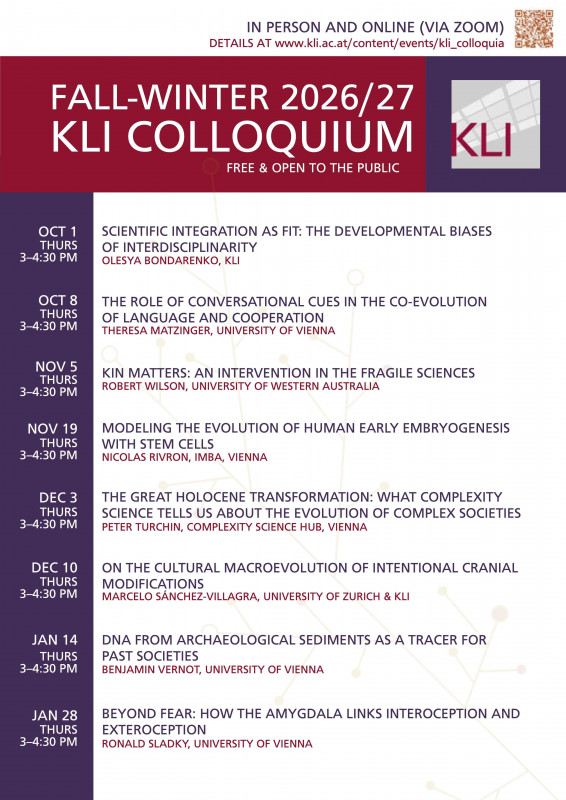
Scientific Integration as Fit: The Developmental Biases of Interdisciplinarity
Olesya BONDARENKO (KLI)
8 October 2026 (Thurs) 3-4:30 PM CET
The Role of Conversational Cues in the Co-Evolution of Language and Cooperation
Theresa MATZINGER (University of Vienna)
5 November 2026 (Thurs) 3-4:30 PM CET
Kin Matters: An Intervention in the Fragile Sciences
Robert A. WILSON (University of Western Australia)
19 November 2026 (Thurs) 3-4:30 PM CET
Modeling the Evolution of Human Early Embryogenesis with Stem Cells
Nicolas RIVRON (Institute of Molecular Biotechnology/IMBA, Vienna)
3 December 2026 (Thurs) 3-4:30 PM CET
Peter TURCHIN (Complexity Science Hub, Vienna)
10 December 2026 (Thurs) 3-4:30 PM CET
On the Cultural Macroevolution of Intentional Cranial Modifications
Marcelo SÁNCHEZ-VILLAGRA (University of Zurich)
14 January 2027 (Thurs) 3-4:30 PM CET
DNA from Archaeological Sediments as a Tracer for Past Societies
Benjamin VERNOT (University of Vienna)
28 January 2027 (Thurs) 3-4:30 PM CET
Beyond Fear: How the Amygdala Links Interoception and Exteroception
Ronald SLADKY (University of Vienna)
KLI Colloquia 2014 – 2026
Event Details

Topic description / abstract:
Macaques (Old World monkeys of the genus Macaca) are widespread across Asia and found in relict populations in northern Africa. Today represented by over 20 species, Macaca evolved in Africa in the late Miocene and dispersed into Eurasia, probably initially around the Mediterranean, colonising Europe to ~53˚N, and much of tropical and subtropical Asia plus some of its temperate regions. Some modern species are found in small geographic areas but others are spread over huge geographic ranges. The crab-eating (or long-tailed) macaque, Macaca fascicularis, is one such species, distributed across southeast Asia, from Bangladesh to Indonesia and the Philippines. Although M. fascicularis populations are declining, the species is classed as Least Concern in the IUCN Red List, and occupies a large number of different forested and shrubland habitats. I will report on work in progress with colleagues at the KLI that aims to quantify the morphological diversity in M. fascicularis, using a large geometric morphometric database of macaque skulls. Our ultimate aim is to determine whether morphological variation occurs because of phenotypic plasticity, or whether M. fascicularis specimens from the same geographic area (as a proxy for population) show evidence of local adaptation. The study of plasticity (expression of different phenotypes in different environments) versus local adaptation (genetic divergence) has been a fruitful area of botanical research, and we are excited to apply it to the fascinating macaques. By doing so, we hope to contribute to conservation efforts by gaining a better understanding of macaque diversity and the processes by which it arises.
Biosketch
Sarah Elton is Professor of Evolutionary Anthropology at Durham University, UK. She previously held posts at the University of Kent and the Hull York Medical School. Her research focuses on morphological variation and evolution in Old World monkeys, with a particular interest in geographic and ecological influences on form. Sarah trained as a biological anthropologist and as result of her time working in a medical school also has an active interest in evolutionary perspectives on medicine, especially nutrition. For several years she was co-Editor in Chief of the Journal of Human Evolution (JHE) and currently serves as Associate Editor of JHE, Evolutionary Anthropology, the Journal of the Royal Anthropological Institute and Primate Biology.
