
KLI Colloquia are invited research talks of about an hour followed by 30 min discussion. The talks are held in English, open to the public, and offered in hybrid format.
Join via Zoom:
https://us02web.zoom.us/j/5881861923?omn=85945744831
Meeting ID: 588 186 1923
Spring-Summer 2026 KLI Colloquium Series
12 March 2026 (Thurs) 3-4:30 PM CET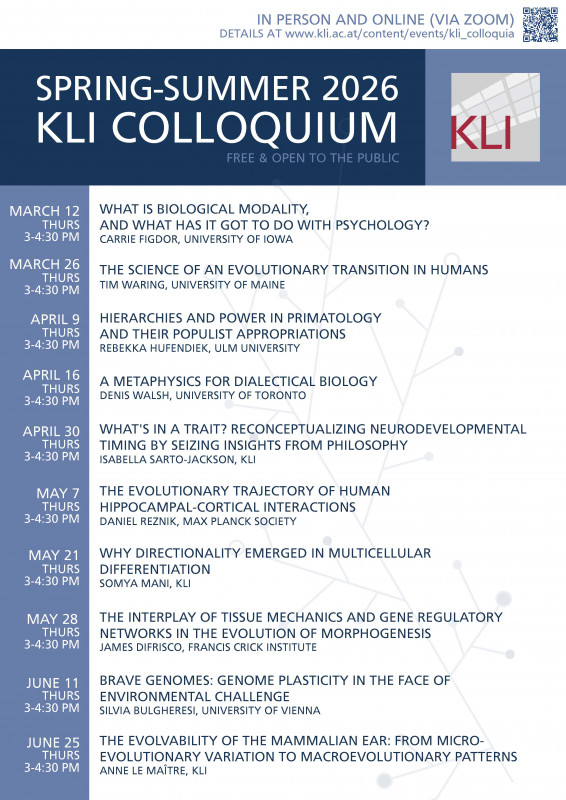
What Is Biological Modality, and What Has It Got to Do With Psychology?
Carrie Figdor (University of Iowa)
26 March 2026 (Thurs) 3-4:30 PM CET
The Science of an Evolutionary Transition in Humans
Tim Waring (University of Maine)
9 April 2026 (Thurs) 3-4:30 PM CET
Hierarchies and Power in Primatology and Their Populist Appropriation
Rebekka Hufendiek (Ulm University)
16 April 2026 (Thurs) 3-4:30 PM CET
A Metaphysics for Dialectical Biology
Denis Walsh (University of Toronto)
30 April 2026 (Thurs) 3-4:30 PM CET
What's in a Trait? Reconceptualizing Neurodevelopmental Timing by Seizing Insights From Philosophy
Isabella Sarto-Jackson (KLI)
7 May 2026 (Thurs) 3-4:30 PM CET
The Evolutionary Trajectory of Human Hippocampal-Cortical Interactions
Daniel Reznik (Max Planck Society)
21 May 2026 (Thurs) 3-4:30 PM CET
Why Directionality Emerged in Multicellular Differentiation
Somya Mani (KLI)
28 May 2026 (Thurs) 3-4:30 PM CET
The Interplay of Tissue Mechanics and Gene Regulatory Networks in the Evolution of Morphogenesis
James DiFrisco (Francis Crick Institute)
11 June 2026 (Thurs) 3-4:30 PM CET
Brave Genomes: Genome Plasticity in the Face of Environmental Challenge
Silvia Bulgheresi (University of Vienna)
25 June 2026 (Thurs) 3-4:30 PM CET
Anne LeMaitre (KLI)
KLI Colloquia 2014 – 2026
Event Details

Topic description / abstract:
Writing scientific papers is, arguably, the most important task in a scientist’s working life. Papers are the universal currency by which scientists are compared and evaluated. For most scientists, papers will be the only scientific legacies they leave behind. Unfortunately, scientific papers are imperfect records of scientific activity. Papers present a cleaned-up, simplified and reorganized version of the scientific process, leaving out any detail that might distract the reader from understanding the paper’s findings. In addition, although a paper is “true” when published, its truth diminishes with time, as new knowledge emerges that questions its claims. Finally, a paper can take on entirely new, unintended and possibly erroneous meaning, when it is cited by other papers. One might even say that words are put in its mouth!
Since June 2016, in an attempt to provide a more realistic documentation of the scientific process, I have conducted 153 interviews (+20 still in progress), each based on a famous paper in ecology, evolution or behaviour. In these interviews, I ask the lead author of the paper questions about: 1. the making of the study and paper; 2. the current validity of the paper’s findings and conclusions; 3. the impact the paper has had on subsequent research and the author’s own career. During my colloquium, I will present excerpts from these interviews that will, hopefully, give you a flavour of the themes I’ve covered.
Biographical note:
Hari Sridhar is a post-doctoral researcher at the National Centre for Biological Sciences, Bangalore, examining the intersection of science and conservation in India. Over the last 4 years, Hari has been conducting interviews of authors of classic papers in ecology, evolution and behaviour, which he posts on the blog https://reflectionsonpaperspast.wordpress.com/
Hari’s other major research interest lies in understanding the causes and consequences of heterospecific sociality, a topic he has researched during his PhD and post-doctoral research at the Indian Institute of Science, Bangalore. In addition to doing research, Hari teaches ecology and ornithology at various research institutes and colleges in India, and is an editor of the Current Conservation magazine.
