
KLI Colloquia are invited research talks of about an hour followed by 30 min discussion. The talks are held in English, open to the public, and offered in hybrid format.
Join via Zoom:
https://us02web.zoom.us/j/5881861923?omn=85945744831
Meeting ID: 588 186 1923
Fall-Winter 2026/27 KLI Colloquium Series
1 October 2026 (Thurs) 3-4:30 PM CET 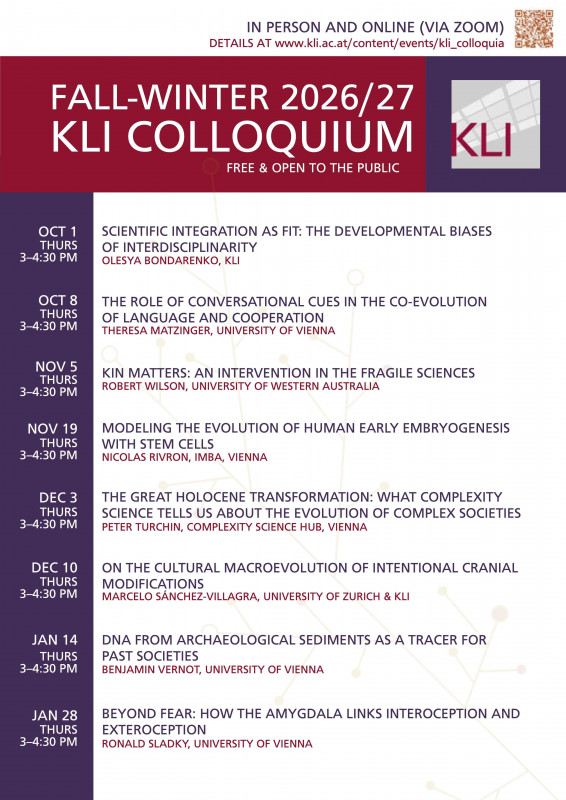
Scientific Integration as Fit: The Developmental Biases of Interdisciplinarity
Olesya BONDARENKO (KLI)
8 October 2026 (Thurs) 3-4:30 PM CET
The Role of Conversational Cues in the Co-Evolution of Language and Cooperation
Theresa MATZINGER (University of Vienna)
5 November 2026 (Thurs) 3-4:30 PM CET
Kin Matters: An Intervention in the Fragile Sciences
Robert A. WILSON (University of Western Australia)
19 November 2026 (Thurs) 3-4:30 PM CET
Modeling the Evolution of Human Early Embryogenesis with Stem Cells
Nicolas RIVRON (Institute of Molecular Biotechnology/IMBA, Vienna)
3 December 2026 (Thurs) 3-4:30 PM CET
Peter TURCHIN (Complexity Science Hub, Vienna)
10 December 2026 (Thurs) 3-4:30 PM CET
On the Cultural Macroevolution of Intentional Cranial Modifications
Marcelo SÁNCHEZ-VILLAGRA (University of Zurich)
14 January 2027 (Thurs) 3-4:30 PM CET
DNA from Archaeological Sediments as a Tracer for Past Societies
Benjamin VERNOT (University of Vienna)
28 January 2027 (Thurs) 3-4:30 PM CET
Beyond Fear: How the Amygdala Links Interoception and Exteroception
Ronald SLADKY (University of Vienna)
KLI Colloquia 2014 – 2026
Event Details

Topic description / abstract:
2019 marks 75 years since Erwin Schrödinger, one of the most celebrated physicists of the twentieth century, turned his attention to biology and published a little book titled What is Life? The Physical Aspect of the Living Cell. Much has been written on the book’s instrumental role in marshalling an entire generation of physicists to enter the new field that came to be known as ‘molecular biology’. Scientifically, the importance of What is Life? is generally taken to lie in having introduced the idea that the hereditary material (at the time it hadn’t yet been conclusively identified as DNA) contains a ‘code-script’ that specifies the information necessary for the developmental construction of an organism. Most retrospective evaluations converge in praising the book for having exerted a highly positive influence on the development of molecular biology. In this talk I challenge this widely accepted interpretation by carefully dissecting the argument that Schrödinger sets out in What is Life?, which concerns the nature of biological order. Schrödinger clearly demarcates the kind of order found in the physical world, which is based on the statistical averaging of vast numbers of stochastically-acting molecules that collectively display regular, law-like patterns of behaviour, from the kind of order found in the living world, which has its basis in the chemical structure of a single molecule, the self-replicating chromosome, which he conceived as a solid-state ‘aperiodic crystal’ in order to account for its remarkable stability in the face of stochastic perturbations. Schrödinger referred to the former, physical kind of order as ‘order-from-disorder’ and the latter, biological kind of order as ‘order-from-order’. As I will argue, this demarcation proved disastrous for molecular biology, for it granted molecular biologists the licence for over half a century to legitimately disregard the impact of stochasticity at the molecular scale (despite being inevitable from a physical point of view), encouraging them instead to develop a highly idealized, deterministic view of the molecular mechanisms underlying the cell, which are still today often misleadingly characterized as fixed, solid-state ‘circuits’. It has taken molecular biologists a disturbingly long time to ‘unlearn’ Schrödinger’s lessons regarding biological order and to start taking seriously the role of self-organization and stochasticity (or ‘noise’), and this, I claim, should be considered the real scientific legacy of What is Life? 75 years on.
Biographical note:
Daniel Nicholson is a senior research fellow at the KLI. His work is characterized by an integrated and strongly interdisciplinary approach to the history and philosophy of biology. His current research focuses on the ontology of living systems, particularly on the ways in which organisms differ from other complex organized systems like machines, and on the implications that these differences have for biological theory. He also has a longstanding interest in the historical development of theoretical and philosophical reflections on biology. Dan holds a PhD in philosophy (Exeter) as well as masters degrees in history and philosophy of science (Leeds) and molecular and cellular biology (Bath). Prior to returning to the KLI, Dan was a research fellow at the Centre for the Study of Life Sciences (Exeter) and at the Cohn Institute for the History and Philosophy of Science and Ideas (Tel Aviv).
