

KLI Colloquia are invited research talks of about an hour followed by 30 min discussion. The talks are held in English, open to the public, and offered in hybrid format.
Join via Zoom:
https://us02web.zoom.us/j/5881861923?omn=85945744831
Meeting ID: 588 186 1923
Fall-Winter 2026/27 KLI Colloquium Series
1 October 2026 (Thurs) 3-4:30 PM CET 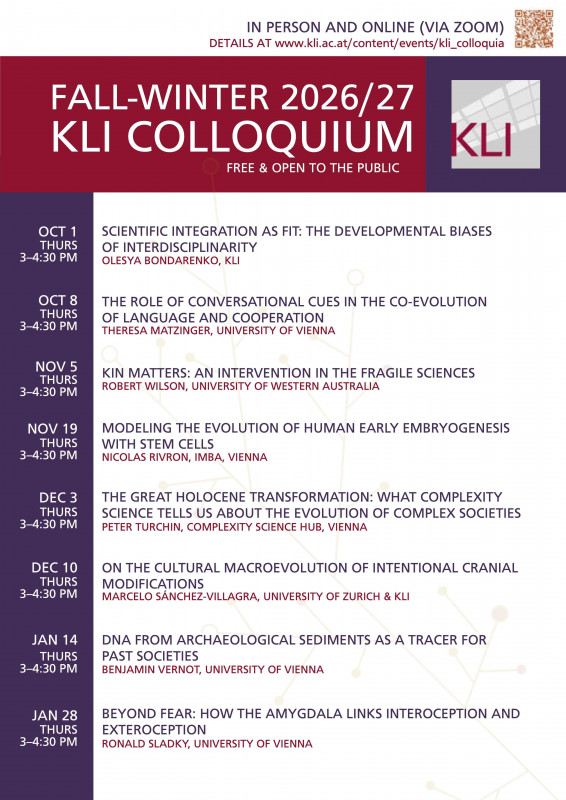
Scientific Integration as Fit: The Developmental Biases of Interdisciplinarity
Olesya BONDARENKO (KLI)
8 October 2026 (Thurs) 3-4:30 PM CET
The Role of Conversational Cues in the Co-Evolution of Language and Cooperation
Theresa MATZINGER (University of Vienna)
5 November 2026 (Thurs) 3-4:30 PM CET
Kin Matters: An Intervention in the Fragile Sciences
Robert A. WILSON (University of Western Australia)
19 November 2026 (Thurs) 3-4:30 PM CET
Modeling the Evolution of Human Early Embryogenesis with Stem Cells
Nicolas RIVRON (Institute of Molecular Biotechnology/IMBA, Vienna)
3 December 2026 (Thurs) 3-4:30 PM CET
Peter TURCHIN (Complexity Science Hub, Vienna)
10 December 2026 (Thurs) 3-4:30 PM CET
On the Cultural Macroevolution of Intentional Cranial Modifications
Marcelo SÁNCHEZ-VILLAGRA (University of Zurich)
14 January 2027 (Thurs) 3-4:30 PM CET
DNA from Archaeological Sediments as a Tracer for Past Societies
Benjamin VERNOT (University of Vienna)
28 January 2027 (Thurs) 3-4:30 PM CET
Beyond Fear: How the Amygdala Links Interoception and Exteroception
Ronald SLADKY (University of Vienna)
KLI Colloquia 2014 – 2026
Event Details

Topic description / abstract:
Interdisciplinary collaboration requires researchers to navigate multiple challenges of teamwork. Such challenges have both epistemic and interpersonal qualities. While researchers may enter collaborations with considerable expertise in their own field, they may find themselves under-prepared to address the collaborative challenges they encounter.
During my recent doctoral research, I developed a methodology called formative accompanying research (FAR). Using FAR, I tracked an interdisciplinary collaboration in the field of sustainability science. This has deepened my understanding of dynamics of collaboration in research teams. It has also provided considerable insight into navigating positionality and relationality as a boundary-crossing researcher.
This presentation will introduce the FAR methodology for studying collaboration, identify common challenges in collaboration and propose capacities that can be cultivated to address these challenges. How can difficult experiences of collaborating deliberately be used as opportunities to learn to collaborate? The role of discomfort in collaboration will be introduced as a prompt for learning to collaborate while collaborating.
I will illustrate the conceptual input with illustrations from recent experiences in the interdisciplinary project Leverage Points for Sustainability Transformation. A brief exploration of this case will give rise to key insights that may be recognisable in other cases with which participants are familiar. It is intended that this will lead to a discussion with participants about their own experiences of collaboration challenges and strategies for enhancing collaboration.
Biographical note:
Rebecca Freeth is a dialogue facilitator, researcher and writer. The joys and challenges of meaningful collaboration have been a source of interest and practice for many years. She has initiated and supported long-term multi-sector dialogue and action projects and also specializes in working collaborating towards uncertain futures. Much of her work has been located in post-apartheid South Africa, which is her primary home. She teaches on numerous university courses for under- and postgraduate students, as well as a ‘systems thinking for social change’ summer school. Her recently completed doctoral research, in which she tracked an interdisciplinary collaboration in the field of sustainability science for three years, has deepened her understanding of dynamics of collaboration in research teams. Rebecca is currently a senior fellow at the Institute for Advanced Sustainability Science (IASS), in Potsdam Germany.
