

KLI Colloquia are invited research talks of about an hour followed by 30 min discussion. The talks are held in English, open to the public, and offered in hybrid format.
Join via Zoom:
https://us02web.zoom.us/j/5881861923?omn=85945744831
Meeting ID: 588 186 1923
Fall-Winter 2026/27 KLI Colloquium Series
1 October 2026 (Thurs) 3-4:30 PM CET 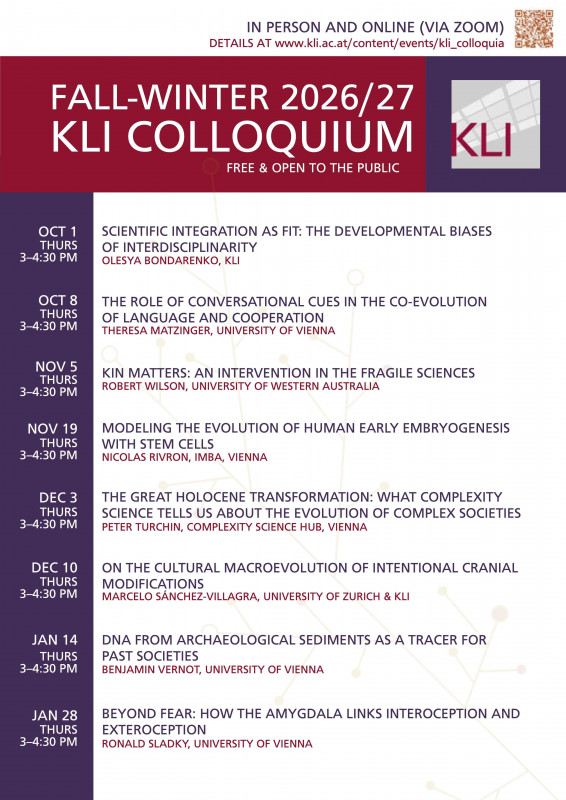
Scientific Integration as Fit: The Developmental Biases of Interdisciplinarity
Olesya BONDARENKO (KLI)
8 October 2026 (Thurs) 3-4:30 PM CET
The Role of Conversational Cues in the Co-Evolution of Language and Cooperation
Theresa MATZINGER (University of Vienna)
5 November 2026 (Thurs) 3-4:30 PM CET
Kin Matters: An Intervention in the Fragile Sciences
Robert A. WILSON (University of Western Australia)
19 November 2026 (Thurs) 3-4:30 PM CET
Modeling the Evolution of Human Early Embryogenesis with Stem Cells
Nicolas RIVRON (Institute of Molecular Biotechnology/IMBA, Vienna)
3 December 2026 (Thurs) 3-4:30 PM CET
Peter TURCHIN (Complexity Science Hub, Vienna)
10 December 2026 (Thurs) 3-4:30 PM CET
On the Cultural Macroevolution of Intentional Cranial Modifications
Marcelo SÁNCHEZ-VILLAGRA (University of Zurich)
14 January 2027 (Thurs) 3-4:30 PM CET
DNA from Archaeological Sediments as a Tracer for Past Societies
Benjamin VERNOT (University of Vienna)
28 January 2027 (Thurs) 3-4:30 PM CET
Beyond Fear: How the Amygdala Links Interoception and Exteroception
Ronald SLADKY (University of Vienna)
KLI Colloquia 2014 – 2026
Event Details

Topic description / abstract:
The genetic foundations of animal domestication have been a major puzzle since 1868 when Charles Darwin delineated it as a scientific problem in his massive book on heredity, Variation in Domesticated Plants and Animals. more than 30 years before there was a recognized science of heredity. A chief discovery of Darwin’s was that domestication seems to be accompanied by a suite of morphological and physiological traits that have little obvious connection to the core features of domestication itself. These associated characteristics have been termed the “domestication syndrome”. In recent years, a new hypothesis and a raft of new genomic findings have begun to promise a new set of insights into the domestication syndrome and the traits of tameness and reproductive behavior that define “domestication”. The findings so far apply most clearly to domesticated mammals but are probably also relevant to the handful of bird and fish species that have experienced domestication. The evidence and the new perspective will be discussed in this talk, along with the indications that the phenomenon of domestication may have relevance to human evolution.
Biographical note:
Adam Wilkins is a geneticist and evolutionary biologist and is currently a Senior Fellow at Humboldt University in Berlin, Germany. Wilkins obtained a B.A. from Reed College in Portland, Oregon, and a Ph.D. in genetics from the University of Washington in Seattle. He completed post-doctoral fellowships at Massachusetts Institute of Technology and the University of Wisconsin. His books include Genetic Analysis of Animal Development (Wiley & Sons, 1986, 1993) and The Evolution of Developmental Pathways (Sinauer, 2002). From 1990 to 2008, Dr. Wilkins was editor of BioEssays and is currently editor of the “Perspectives” section of GENETICS.
