

KLI Colloquia are invited research talks of about an hour followed by 30 min discussion. The talks are held in English, open to the public, and offered in hybrid format.
Join via Zoom:
https://us02web.zoom.us/j/5881861923?omn=85945744831
Meeting ID: 588 186 1923
Fall-Winter 2026/27 KLI Colloquium Series
1 October 2026 (Thurs) 3-4:30 PM CET 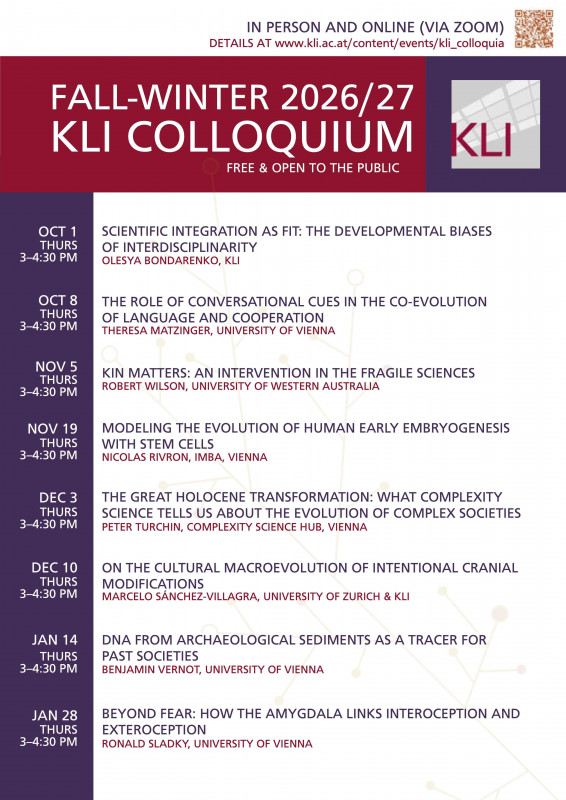
Scientific Integration as Fit: The Developmental Biases of Interdisciplinarity
Olesya BONDARENKO (KLI)
8 October 2026 (Thurs) 3-4:30 PM CET
The Role of Conversational Cues in the Co-Evolution of Language and Cooperation
Theresa MATZINGER (University of Vienna)
5 November 2026 (Thurs) 3-4:30 PM CET
Kin Matters: An Intervention in the Fragile Sciences
Robert A. WILSON (University of Western Australia)
19 November 2026 (Thurs) 3-4:30 PM CET
Modeling the Evolution of Human Early Embryogenesis with Stem Cells
Nicolas RIVRON (Institute of Molecular Biotechnology/IMBA, Vienna)
3 December 2026 (Thurs) 3-4:30 PM CET
Peter TURCHIN (Complexity Science Hub, Vienna)
10 December 2026 (Thurs) 3-4:30 PM CET
On the Cultural Macroevolution of Intentional Cranial Modifications
Marcelo SÁNCHEZ-VILLAGRA (University of Zurich)
14 January 2027 (Thurs) 3-4:30 PM CET
DNA from Archaeological Sediments as a Tracer for Past Societies
Benjamin VERNOT (University of Vienna)
28 January 2027 (Thurs) 3-4:30 PM CET
Beyond Fear: How the Amygdala Links Interoception and Exteroception
Ronald SLADKY (University of Vienna)
KLI Colloquia 2014 – 2026
Event Details

Topic description / abstract:
Animal innovations range from the discovery of novel food types to the invention of completely novel behaviours. Sparrows, for example, have learned to trigger the automatic doors of supermarkets to gain access to crisp packages; black kites carry burning twigs to other sites to spread bush fires and flush out their prey; chimpanzees use sticks to spear bush babies out of tree holes. We are fascinated and intrigued by these examples of animal innovation. They suggest, to some extent, that animals are akin to us in their ability to find novel solutions to problems, leading to the question whether these abilities are based on a similar cognitive mechanism. While this question has received some scientific attention during the last years, the evolutionary potential of behavioural innovations has received comparatively less consideration. Behaviour and underlying cognitive mechanisms are not only shaped by selection, behaviour is also a driver for evolution. Behavioural innovations have played an important role in our own evolutionary trajectory as well as in that of other animals. Innovations can give access to new opportunities, for instance novel food sources, and thus enable innovators to invade and create novel niches. This in turn can pave the way for morphological adaptation and adaptive radiation. In my talk I will present a theoretical framework that describes the interactions between underlying mechanisms, fitness benefits, and evolutionary significance of innovations and illustrate it with animal and human examples. Using Darwin’s finches as a model, I will exemplify the evolutionary potential of innovation, discuss underlying mechanisms that are shared between animals and humans, and present data that sheds light on the ecological drivers for innovativeness.
Biographical note:
Sabine Tebbich is a behavioural biologist with broad research interests, ranging from animal cognition, behavioural flexibility to host-parasite interactions and conservation. Her main model systems are Darwin’s finches but she has also done research on insects, fish, and humans. In the past she has been affiliated with the Max-Planck Institute for Physiology in Seewiesen, Germany, University of Cambridge, and University of St. Andrews. Her current affiliation is with the University of Vienna
