
KLI Colloquia are invited research talks of about an hour followed by 30 min discussion. The talks are held in English, open to the public, and offered in hybrid format.
Join via Zoom:
https://us02web.zoom.us/j/5881861923?omn=85945744831
Meeting ID: 588 186 1923
Fall-Winter 2026/27 KLI Colloquium Series
1 October 2026 (Thurs) 3-4:30 PM CET 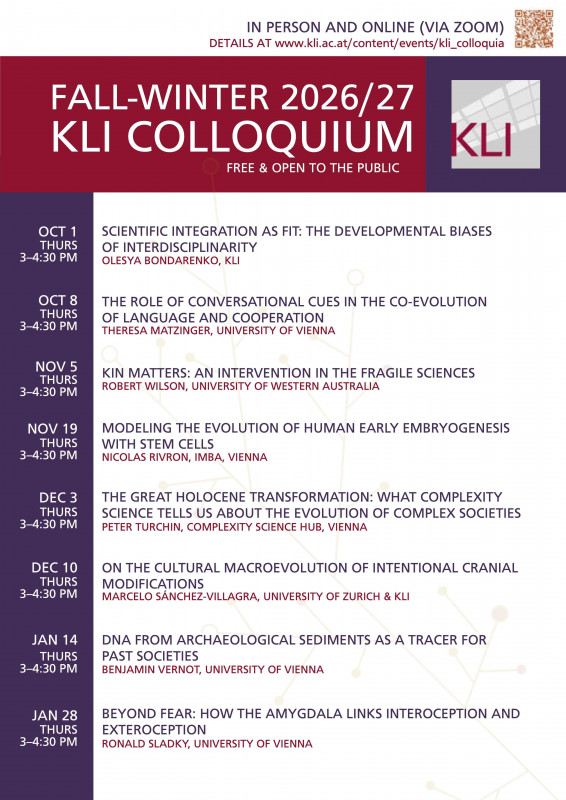
Scientific Integration as Fit: The Developmental Biases of Interdisciplinarity
Olesya BONDARENKO (KLI)
8 October 2026 (Thurs) 3-4:30 PM CET
The Role of Conversational Cues in the Co-Evolution of Language and Cooperation
Theresa MATZINGER (University of Vienna)
5 November 2026 (Thurs) 3-4:30 PM CET
Kin Matters: An Intervention in the Fragile Sciences
Robert A. WILSON (University of Western Australia)
19 November 2026 (Thurs) 3-4:30 PM CET
Modeling the Evolution of Human Early Embryogenesis with Stem Cells
Nicolas RIVRON (Institute of Molecular Biotechnology/IMBA, Vienna)
3 December 2026 (Thurs) 3-4:30 PM CET
Peter TURCHIN (Complexity Science Hub, Vienna)
10 December 2026 (Thurs) 3-4:30 PM CET
On the Cultural Macroevolution of Intentional Cranial Modifications
Marcelo SÁNCHEZ-VILLAGRA (University of Zurich)
14 January 2027 (Thurs) 3-4:30 PM CET
DNA from Archaeological Sediments as a Tracer for Past Societies
Benjamin VERNOT (University of Vienna)
28 January 2027 (Thurs) 3-4:30 PM CET
Beyond Fear: How the Amygdala Links Interoception and Exteroception
Ronald SLADKY (University of Vienna)
KLI Colloquia 2014 – 2026
Event Details

Topic description / abstract:
Innovation is a universal characteristic of evolving complex systems. This includes organisms as well as technologies, economics as well as social systems. But not all innovations are equal. Most are variations of existing characters or technologies, some involve novel recombination of existing parts, and very few are truly “major transitions.” Evolutionary biologists have long recognized the existence of such major transitions. Recently a better understanding of such major transitions emerged, one that highlights the close connections between all evolving systems (biological, technological, economic). One defining feature of all major transitions is that these involve the emergence of novel platforms (generally defined) that facilitate further differentiation and diversification within these systems. One consequence of major transitions is that they open up new domains (of life or technology) and therefore also of new evolutionary dynamics and opportunities. Capturing these dynamics also involves a novel approach to understanding evolution (extended evolution theory), which is far better suited to capture technological, economic and social systems than the simple application of models of selection that has characterized much of evolutionary economics.
Biographical note:
Manfred Laubichler is President's Professor of Theoretical Biology and History of Biology and Director of the Global Biosocial Complexity Initiative at Arizona State University. His work focuses on evolutionary novelties from genomes to knowledge systems, the structure of evolutionary theory and the evolution of knowledge. His undergraduate training was in zoology, philosophy and mathematics at the University of Vienna (Austria) and his graduate training was in biology at Yale and in History/History of Science at Princeton. He is an external professor at the Santa Fe Institute and co-director of the ASU-SFI Center for Biosocial Complex Systems, an adjunct scientist with the Marine Biological Laboratory at Woods Hole, MA, a visiting scholar at the Max Planck Institute for the History of Science in Berlin, Germany, external faculty member at the Complexity Science Hub Vienna, and Guest Professor at Leuphana University in Lüneburg, Germany. He has been affiliated with the KLI for many years, most recently as a member of the scientific advisory board. He is also an elected fellow of the American Association for the Advancement of Science, a former fellow of the Wissenschaftskolleg zu Berlin and Vice Chair of the Global Climate Forum.
