
KLI Colloquia are invited research talks of about an hour followed by 30 min discussion. The talks are held in English, open to the public, and offered in hybrid format.
Join via Zoom:
https://us02web.zoom.us/j/5881861923?omn=85945744831
Meeting ID: 588 186 1923
Fall-Winter 2026/27 KLI Colloquium Series
1 October 2026 (Thurs) 3-4:30 PM CET 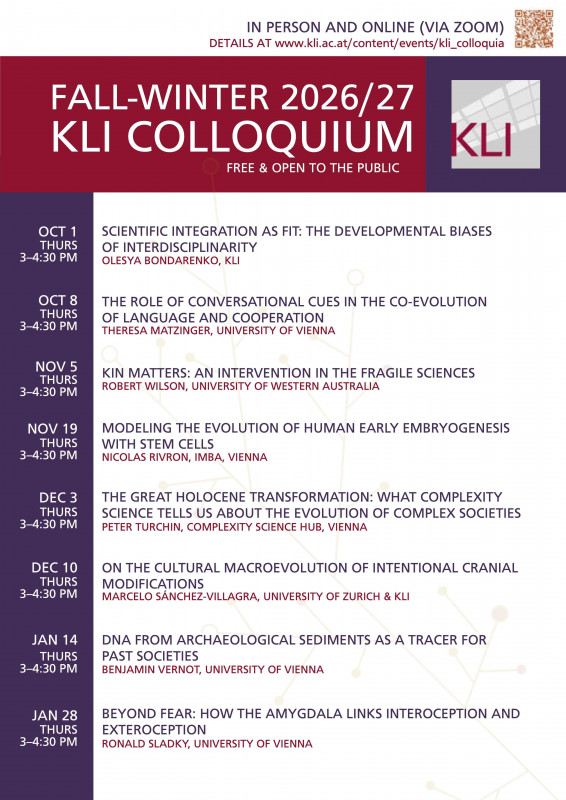
Scientific Integration as Fit: The Developmental Biases of Interdisciplinarity
Olesya BONDARENKO (KLI)
8 October 2026 (Thurs) 3-4:30 PM CET
The Role of Conversational Cues in the Co-Evolution of Language and Cooperation
Theresa MATZINGER (University of Vienna)
5 November 2026 (Thurs) 3-4:30 PM CET
Kin Matters: An Intervention in the Fragile Sciences
Robert A. WILSON (University of Western Australia)
19 November 2026 (Thurs) 3-4:30 PM CET
Modeling the Evolution of Human Early Embryogenesis with Stem Cells
Nicolas RIVRON (Institute of Molecular Biotechnology/IMBA, Vienna)
3 December 2026 (Thurs) 3-4:30 PM CET
Peter TURCHIN (Complexity Science Hub, Vienna)
10 December 2026 (Thurs) 3-4:30 PM CET
On the Cultural Macroevolution of Intentional Cranial Modifications
Marcelo SÁNCHEZ-VILLAGRA (University of Zurich)
14 January 2027 (Thurs) 3-4:30 PM CET
DNA from Archaeological Sediments as a Tracer for Past Societies
Benjamin VERNOT (University of Vienna)
28 January 2027 (Thurs) 3-4:30 PM CET
Beyond Fear: How the Amygdala Links Interoception and Exteroception
Ronald SLADKY (University of Vienna)
KLI Colloquia 2014 – 2026
Event Details

Topic description / abstract:
Despite rapid medical and technological advancements, modern humans are still subject to natural selection, and this goes beyond negative selection on life-threatening diseases. Sociocultural transitions and medical advancements can disrupt evolutionary equilibriums underlying modern human anatomy, physiology and life history. Using examples from childbirth and obstructed labor, autoimmune disorders, and sickle cell disease, I demonstrate how regular medical interventions can disrupt such evolved equilibriums and trigger new evolutionary changes with the potential to affect our bodies and health within only a few generations. Disentangling such complex biosocial evolutionary dynamics poses serious ethical questions and challenges the current borders between academic disciplines, but it has strong potential for guiding public health policies.
Biographical note:
Philipp Mitteroecker is associate professor of theoretical biology at the University of Vienna. He is also teaching at the University of Graz, and he is a directorial board member of the KLI Institute for Evolution & Cognition Research. His research interests include human and animal evolution, evolutionary medicine, biological anthropology, biostatistics, and the philosophy of science. He is particularly interested in the analysis of complex biological data, including morphometric, genetic, and demographic data, to understand and model the interaction of developmental, environmental, and evolutionary processes. Recent work includes the evolution and current transition of human childbirth and reproductive anatomy.
