

KLI Colloquia are invited research talks of about an hour followed by 30 min discussion. The talks are held in English, open to the public, and offered in hybrid format.
Join via Zoom:
https://us02web.zoom.us/j/5881861923?omn=85945744831
Meeting ID: 588 186 1923
Fall-Winter 2026/27 KLI Colloquium Series
1 October 2026 (Thurs) 3-4:30 PM CET 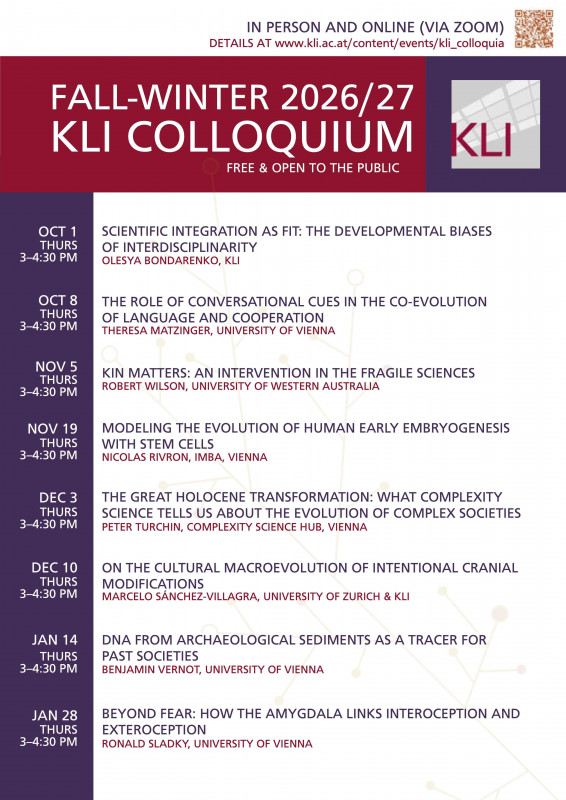
Scientific Integration as Fit: The Developmental Biases of Interdisciplinarity
Olesya BONDARENKO (KLI)
8 October 2026 (Thurs) 3-4:30 PM CET
The Role of Conversational Cues in the Co-Evolution of Language and Cooperation
Theresa MATZINGER (University of Vienna)
5 November 2026 (Thurs) 3-4:30 PM CET
Kin Matters: An Intervention in the Fragile Sciences
Robert A. WILSON (University of Western Australia)
19 November 2026 (Thurs) 3-4:30 PM CET
Modeling the Evolution of Human Early Embryogenesis with Stem Cells
Nicolas RIVRON (Institute of Molecular Biotechnology/IMBA, Vienna)
3 December 2026 (Thurs) 3-4:30 PM CET
Peter TURCHIN (Complexity Science Hub, Vienna)
10 December 2026 (Thurs) 3-4:30 PM CET
On the Cultural Macroevolution of Intentional Cranial Modifications
Marcelo SÁNCHEZ-VILLAGRA (University of Zurich)
14 January 2027 (Thurs) 3-4:30 PM CET
DNA from Archaeological Sediments as a Tracer for Past Societies
Benjamin VERNOT (University of Vienna)
28 January 2027 (Thurs) 3-4:30 PM CET
Beyond Fear: How the Amygdala Links Interoception and Exteroception
Ronald SLADKY (University of Vienna)
KLI Colloquia 2014 – 2026
Event Details

Topic description:
Moral realists believe that there are objective moral truths. This presentation addresses two related issues at the interface between moral realism, evolution, and folk metaethics. First, I attempt to clarify and assess the underlying empirical hypothesis of Joyce’s recent evolutionary debunking argument against moral realism, i.e., the hypothesis that moral judgements are explained by natural selection. Second, I attempt to clarify and advance the methods of psychological research on folk moral realism (by developing general guidelines for such research and suggesting a new experimental design meant to best satisfy these guidelines). Both of these contributions have the potential to advance our understanding of morality in important respects.
Biographical note:
Thomas Pölzler is a post-doc researcher and lecturer at the Philosophy Department of the University of Graz, Austria. His main areas of research are metaethics and moral psychology. In particular, he is interested in the validity and metaethical relevance of empirical studies on morality (such as studies on folk moral realism, the evolution of morality, and moral judgements’ relation to emotions). Further research interests include the philosophy of Albert Camus, intergenerational justice, environmental ethics, and basic needs. His articles have been published in journals such as Synthese, Review of Philosophy and Psychology, and South African Journal of Philosophy. Currently, he is working on a book manuscript which is under contract with Routledge, entitled “Moral Reality and the Empirical Sciences”.
