

KLI Colloquia are invited research talks of about an hour followed by 30 min discussion. The talks are held in English, open to the public, and offered in hybrid format.
Join via Zoom:
https://us02web.zoom.us/j/5881861923?omn=85945744831
Meeting ID: 588 186 1923
Fall-Winter 2026/27 KLI Colloquium Series
1 October 2026 (Thurs) 3-4:30 PM CET 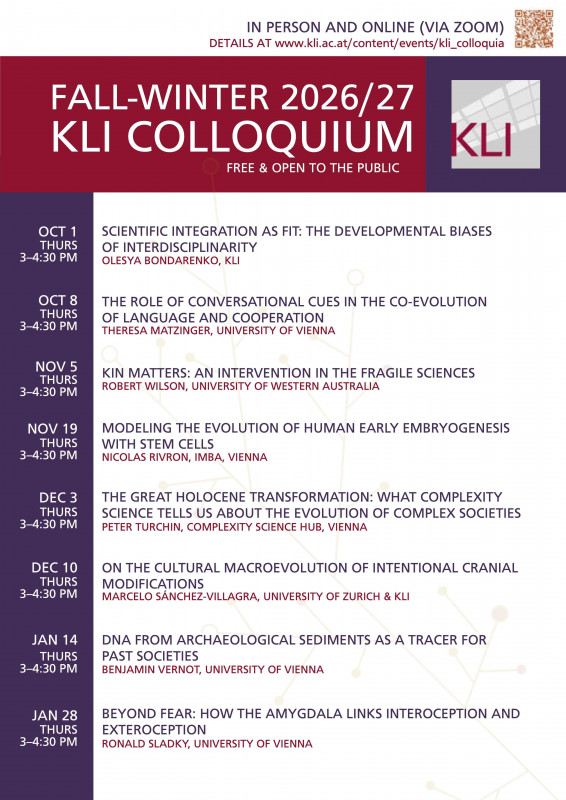
Scientific Integration as Fit: The Developmental Biases of Interdisciplinarity
Olesya BONDARENKO (KLI)
8 October 2026 (Thurs) 3-4:30 PM CET
The Role of Conversational Cues in the Co-Evolution of Language and Cooperation
Theresa MATZINGER (University of Vienna)
5 November 2026 (Thurs) 3-4:30 PM CET
Kin Matters: An Intervention in the Fragile Sciences
Robert A. WILSON (University of Western Australia)
19 November 2026 (Thurs) 3-4:30 PM CET
Modeling the Evolution of Human Early Embryogenesis with Stem Cells
Nicolas RIVRON (Institute of Molecular Biotechnology/IMBA, Vienna)
3 December 2026 (Thurs) 3-4:30 PM CET
Peter TURCHIN (Complexity Science Hub, Vienna)
10 December 2026 (Thurs) 3-4:30 PM CET
On the Cultural Macroevolution of Intentional Cranial Modifications
Marcelo SÁNCHEZ-VILLAGRA (University of Zurich)
14 January 2027 (Thurs) 3-4:30 PM CET
DNA from Archaeological Sediments as a Tracer for Past Societies
Benjamin VERNOT (University of Vienna)
28 January 2027 (Thurs) 3-4:30 PM CET
Beyond Fear: How the Amygdala Links Interoception and Exteroception
Ronald SLADKY (University of Vienna)
KLI Colloquia 2014 – 2026
Event Details
Topic description:
Ian Hacking’s influential work posits that there are some kinds of things that exhibit “looping effects”—that is, they change in response to being classified, in such a way so as to lead to a reconstitution of the kind itself. Such looping effects are important epistemically because they seem to undermine the possibility of obtaining stable causal knowledge about the kinds that exhibit them; looping kinds are “moving targets,” in Hacking’s terms. They are also important because they may be put to work in pragmatic and political contexts, insofar as they may lead to a favourable reconstitution of the kind, or contribute to “ameliorative” projects, as Sally Haslanger discusses in relation to race and gender. The paradigmatic example of things that exhibit such “looping effects” are human kinds. Human kinds are what attract most of Hacking’s attention and he even goes so far as to define human kinds in terms of their tendency to undergo such looping effects. He uses looping to make a distinction between human kinds and natural kinds. But others, such as Rachel Cooper, put pressure on this distinction by pointing out human kinds are not the only kinds of things that undergo looping effects; looping therefore cannot be the basis for a distinction between natural and human kinds. In this talk, I will begin by trying to add some clarity to the discussion of what looping effects are and how they arise, by situating it in relation to the debate about natural versus social and/or human kinds. I will then suggest that empathy might be such a “looping kind”— and consider how this might help to illuminate disagreements surrounding empathy more generally, and also help us to see how we might begin to construct a cultural evolutionary account of empathy, and perhaps other emotions as well.
Biographical note:
Riana Betzler did her undergraduate degree in psychology at Yale University, where she worked with Brian Scholl and Laurie Santos on questions about visual and auditory perception in human adults, Rhesus macaque monkeys, and Capuchin monkeys. At Yale, she also had the opportunity to take courses in history and philosophy, where she became increasingly interested in investigating the background assumptions of her primary field of study: psychology. After finishing her undergraduate research, she decided to take a year to deepen her knowledge of philosophy, history, and literature, by moving to Berlin and studying at the European College of Liberal Arts (now Bard College Berlin). She then went on to do an MPhil in History and Philosophy of Science at the University of Cambridge, where she could fully immerse herself in combining her interests in history, philosophy, and psychology. During her masters program, she worked on a number of topics but primarily focused in on questions in philosophy of psychology, and especially issues surrounding mechanistic explanation in psychology.
After the MPhil, she stayed at Cambridge to do a PhD with Tim Lewens. Her dissertation, titled “Why Empathy? The Pernicious Consequences of Conceptual Confusion in Empathy Research,” investigated the sources of the conceptual confusion that plagues empirical research on empathy, and argued that this confusion is not benign but instead leads to significant problems for projects that seek to put empathy to work in social and political domains. She is currently a research fellow at the KLI, where her project on genealogical approaches and the origins of empathy seeks to extend her PhD work by looking for ways of moving beyond conceptual confusion in the case of empathy.
