

KLI Colloquia are invited research talks of about an hour followed by 30 min discussion. The talks are held in English, open to the public, and offered in hybrid format.
Join via Zoom:
https://us02web.zoom.us/j/5881861923?omn=85945744831
Meeting ID: 588 186 1923
Fall-Winter 2026/27 KLI Colloquium Series
1 October 2026 (Thurs) 3-4:30 PM CET 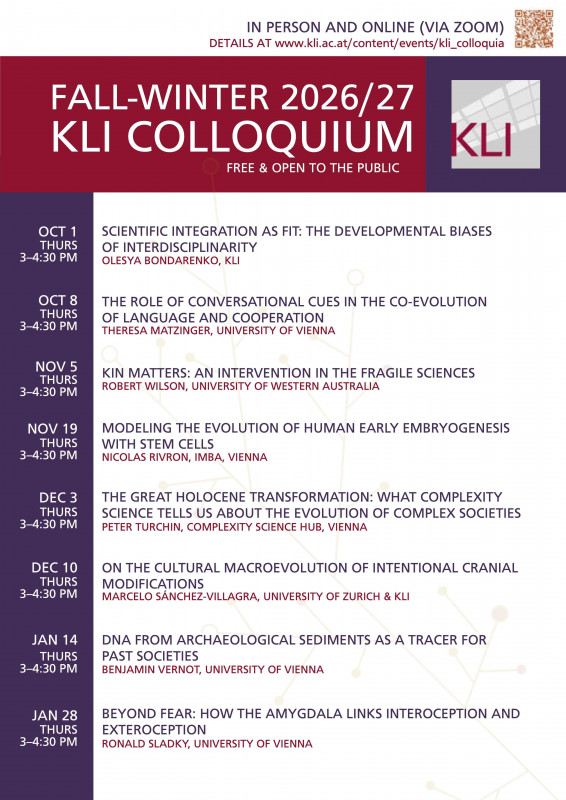
Scientific Integration as Fit: The Developmental Biases of Interdisciplinarity
Olesya BONDARENKO (KLI)
8 October 2026 (Thurs) 3-4:30 PM CET
The Role of Conversational Cues in the Co-Evolution of Language and Cooperation
Theresa MATZINGER (University of Vienna)
5 November 2026 (Thurs) 3-4:30 PM CET
Kin Matters: An Intervention in the Fragile Sciences
Robert A. WILSON (University of Western Australia)
19 November 2026 (Thurs) 3-4:30 PM CET
Modeling the Evolution of Human Early Embryogenesis with Stem Cells
Nicolas RIVRON (Institute of Molecular Biotechnology/IMBA, Vienna)
3 December 2026 (Thurs) 3-4:30 PM CET
Peter TURCHIN (Complexity Science Hub, Vienna)
10 December 2026 (Thurs) 3-4:30 PM CET
On the Cultural Macroevolution of Intentional Cranial Modifications
Marcelo SÁNCHEZ-VILLAGRA (University of Zurich)
14 January 2027 (Thurs) 3-4:30 PM CET
DNA from Archaeological Sediments as a Tracer for Past Societies
Benjamin VERNOT (University of Vienna)
28 January 2027 (Thurs) 3-4:30 PM CET
Beyond Fear: How the Amygdala Links Interoception and Exteroception
Ronald SLADKY (University of Vienna)
KLI Colloquia 2014 – 2026
Event Details

Topic Description:
Despite the ubiquity of 'levels of organization' in the scientific literature, a nascent 'levels skepticism' now claims that the concept of levels is an inherently flawed, misleading, or otherwise inadequate notion for understanding how life scientists produce knowledge about the natural world. However, levels skeptics rely on the maligned “layer-cake” account of levels stemming from Oppenheim and Putnam's (1958) defense of the unity of science for their critical commentary. Recourse to layer-cake levels is understandable, as it is arguably the default conception of levels in philosophy. However, relying on this conception of levels undermines the initial plausibility of general dismissals of the concept because the problems skeptics identify within the “basic idea” of the concept ‘levels’ are merely ones already widely acknowledged of this conception. I illustrate this ‘guilt by association’ by looking at the embedded role of ‘levels’ in articulating intertheoretical reductionism during the latter part of the 20th century. I conclude by suggesting a methodological framework focusing on local usage patterns as a promising means for future analysis of the levels concept.
Biographical note:
Daniel holds Bachelor´s degrees in Philosophy and German Studies from the University of Cincinnati and a Master´s degree in Philosophy from Bielefeld University. In 2014 he completed his Ph.D. studies in Bielefeld under his dissertation project “The Concept of Levels of Organization in Biology”. Before his postdoctoral fellowship at the KLI, Daniel taught graduate and undergraduate seminars in current topics in the philosophy of science and epistemology at the University of Münster.
