
KLI Colloquia are invited research talks of about an hour followed by 30 min discussion. The talks are held in English, open to the public, and offered in hybrid format.
Join via Zoom:
https://us02web.zoom.us/j/5881861923?omn=85945744831
Meeting ID: 588 186 1923
Fall-Winter 2026/27 KLI Colloquium Series
1 October 2026 (Thurs) 3-4:30 PM CET 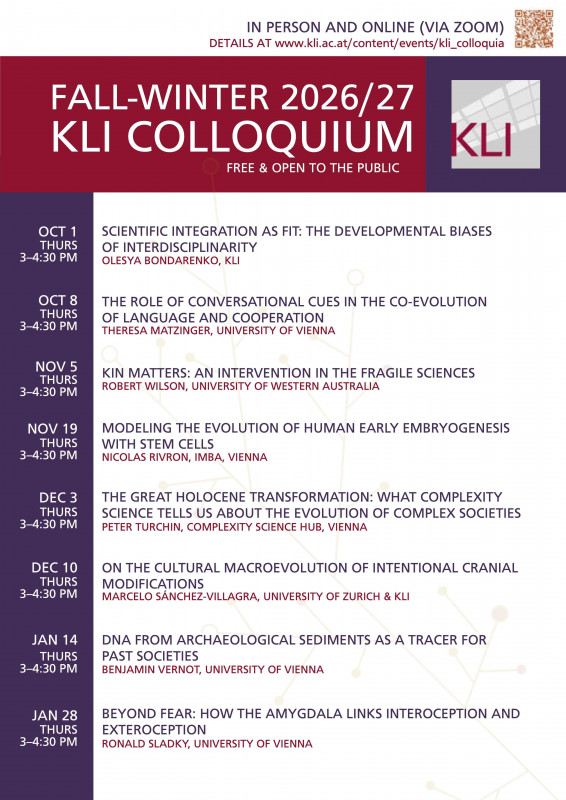
Scientific Integration as Fit: The Developmental Biases of Interdisciplinarity
Olesya BONDARENKO (KLI)
8 October 2026 (Thurs) 3-4:30 PM CET
The Role of Conversational Cues in the Co-Evolution of Language and Cooperation
Theresa MATZINGER (University of Vienna)
5 November 2026 (Thurs) 3-4:30 PM CET
Kin Matters: An Intervention in the Fragile Sciences
Robert A. WILSON (University of Western Australia)
19 November 2026 (Thurs) 3-4:30 PM CET
Modeling the Evolution of Human Early Embryogenesis with Stem Cells
Nicolas RIVRON (Institute of Molecular Biotechnology/IMBA, Vienna)
3 December 2026 (Thurs) 3-4:30 PM CET
Peter TURCHIN (Complexity Science Hub, Vienna)
10 December 2026 (Thurs) 3-4:30 PM CET
On the Cultural Macroevolution of Intentional Cranial Modifications
Marcelo SÁNCHEZ-VILLAGRA (University of Zurich)
14 January 2027 (Thurs) 3-4:30 PM CET
DNA from Archaeological Sediments as a Tracer for Past Societies
Benjamin VERNOT (University of Vienna)
28 January 2027 (Thurs) 3-4:30 PM CET
Beyond Fear: How the Amygdala Links Interoception and Exteroception
Ronald SLADKY (University of Vienna)
KLI Colloquia 2014 – 2026
Event Details

Topic description:
Living systems are fundamentally dynamic, but prevailing mechanistic approaches to understanding life typically focus on their analysis into collections of essentially “static” entities. While basic molecular entities — genes, RNAs, proteins, etc. — clearly provide a vital part of the substrate for life, we also need to understand the origin, nature and inheritance of phenotype, considered as a dynamic pattern of organisation. An individual’s genotype provides only part of the information required to understand its phenotype; environmental (including maternal) conditions also contribute, as illustrated by phenotypic plasticity and polyphenism. The formalism of dynamical systems provides organisational structures that provide a way of addressing these issues. In the context of living systems, an individual’s genotype can be thought of as specifying part of a dynamical system, with additional information coming from the context in which the genotype is expressed. In this view, the genotype “codes” explicitly only for sets of potentialities. I will explore the ways in which dynamical systems provide a perspective on living systems that is more naturally processual than mechanistic, providing the means for understanding how organisation and structure can interact.
Biographical note:
After reading Natural Sciences and Mathematics as an undergraduate, Nick Monk studied for a PhD at Birkbeck College, London with Basil Hiley. At Birkbeck, he contributed to the development of a fully algebraic formalism for quantum mechanics that provides a mathematical realisation of a process-based ontology. Since obtaining his PhD, his research has focused on mathematical modelling of biological phenomena, predominantly in the context of cell and developmental biology. A central concern in this work has been the importance of dynamics in living systems, and a current focus is on the ways in which the structures of dynamical systems can be used to provide a more process-based approach to biology. He has held positions in Oxford, Nottingham and several Departments in Sheffield, and is currently a professor in the School of Mathematics and Statistics at the University of Sheffield, and a Visiting Fellow at the KLI.
