

KLI Colloquia are invited research talks of about an hour followed by 30 min discussion. The talks are held in English, open to the public, and offered in hybrid format.
Join via Zoom:
https://us02web.zoom.us/j/5881861923?omn=85945744831
Meeting ID: 588 186 1923
Fall-Winter 2026/27 KLI Colloquium Series
1 October 2026 (Thurs) 3-4:30 PM CET 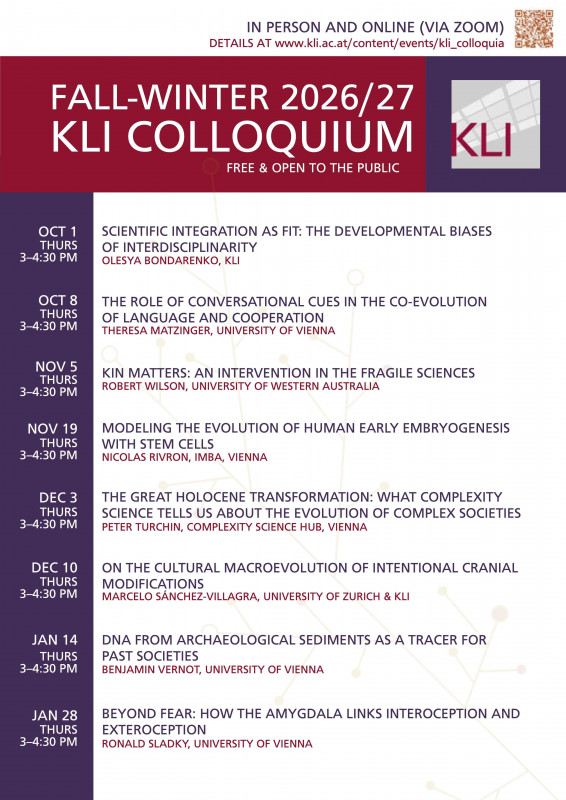
Scientific Integration as Fit: The Developmental Biases of Interdisciplinarity
Olesya BONDARENKO (KLI)
8 October 2026 (Thurs) 3-4:30 PM CET
The Role of Conversational Cues in the Co-Evolution of Language and Cooperation
Theresa MATZINGER (University of Vienna)
5 November 2026 (Thurs) 3-4:30 PM CET
Kin Matters: An Intervention in the Fragile Sciences
Robert A. WILSON (University of Western Australia)
19 November 2026 (Thurs) 3-4:30 PM CET
Modeling the Evolution of Human Early Embryogenesis with Stem Cells
Nicolas RIVRON (Institute of Molecular Biotechnology/IMBA, Vienna)
3 December 2026 (Thurs) 3-4:30 PM CET
Peter TURCHIN (Complexity Science Hub, Vienna)
10 December 2026 (Thurs) 3-4:30 PM CET
On the Cultural Macroevolution of Intentional Cranial Modifications
Marcelo SÁNCHEZ-VILLAGRA (University of Zurich)
14 January 2027 (Thurs) 3-4:30 PM CET
DNA from Archaeological Sediments as a Tracer for Past Societies
Benjamin VERNOT (University of Vienna)
28 January 2027 (Thurs) 3-4:30 PM CET
Beyond Fear: How the Amygdala Links Interoception and Exteroception
Ronald SLADKY (University of Vienna)
KLI Colloquia 2014 – 2026
Event Details

Topic description:
Compared with other primates, childbirth is remarkably difficult in humans because the head of a human neonate is large relative to the birth-relevant dimensions of the maternal pelvis. It seems puzzling that females have not evolved wider pelvises despite the high maternal mortality and morbidity risk connected to childbirth. In this talk, I will discuss hypotheses for why evolution has not resolved this “obstetric dilemma”. I will present some new results indicating that there was adaptation to a certain degree: The dimensions of head, stature, and pelvis in a human body are linked in a complex way that was not recognized before and that contributes to ameliorate this tight fit. We found that females with a large head possess a birth canal that is shaped in a way to better accommodate large-headed neonates. I will furthermore discuss patterns of allometry and sexual dimorphism in the human pelvis as well as some unexpected interpopulation differences.
Biographical note:
Barbara Fischer is a postdoctoral fellow at the KLI since October 2015. She studied Mathematics and Biology at the University of Vienna, and then went on to pursue a PhD in theoretical biology at the University of Bern in Switzerland on the evolution of phenotypic plasticity. During her PhD studies she was also a research assistant at the International Institute of Applied systems analysis (IIASA) in Laxenburg. During her first post-doc at the University of Oslo she continued to work on topics in evolutionary theory and soon developed a specific interest in understanding how adaptation and constraint interplay in determining how phenotypes evolve. Her current main research interests revolve around the evolution of the human pelvis. She applies both theory and empirical approaches using morphological data in this work.
