

KLI Colloquia are invited research talks of about an hour followed by 30 min discussion. The talks are held in English, open to the public, and offered in hybrid format.
Join via Zoom:
https://us02web.zoom.us/j/5881861923?omn=85945744831
Meeting ID: 588 186 1923
Fall-Winter 2026/27 KLI Colloquium Series
1 October 2026 (Thurs) 3-4:30 PM CET 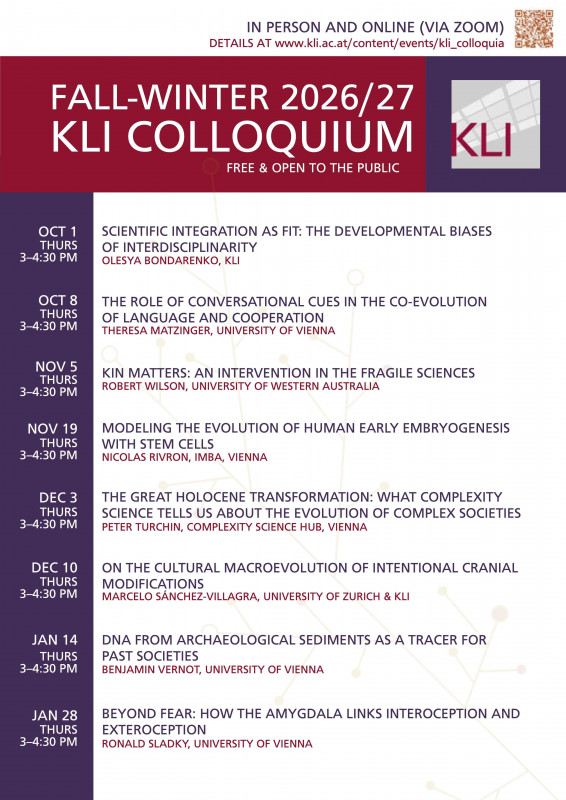
Scientific Integration as Fit: The Developmental Biases of Interdisciplinarity
Olesya BONDARENKO (KLI)
8 October 2026 (Thurs) 3-4:30 PM CET
The Role of Conversational Cues in the Co-Evolution of Language and Cooperation
Theresa MATZINGER (University of Vienna)
5 November 2026 (Thurs) 3-4:30 PM CET
Kin Matters: An Intervention in the Fragile Sciences
Robert A. WILSON (University of Western Australia)
19 November 2026 (Thurs) 3-4:30 PM CET
Modeling the Evolution of Human Early Embryogenesis with Stem Cells
Nicolas RIVRON (Institute of Molecular Biotechnology/IMBA, Vienna)
3 December 2026 (Thurs) 3-4:30 PM CET
Peter TURCHIN (Complexity Science Hub, Vienna)
10 December 2026 (Thurs) 3-4:30 PM CET
On the Cultural Macroevolution of Intentional Cranial Modifications
Marcelo SÁNCHEZ-VILLAGRA (University of Zurich)
14 January 2027 (Thurs) 3-4:30 PM CET
DNA from Archaeological Sediments as a Tracer for Past Societies
Benjamin VERNOT (University of Vienna)
28 January 2027 (Thurs) 3-4:30 PM CET
Beyond Fear: How the Amygdala Links Interoception and Exteroception
Ronald SLADKY (University of Vienna)
KLI Colloquia 2014 – 2026
Event Details

Topic description:
Space is vast and apparently it would be almost hopeless to find far away stars or galaxies without the guidance of their emitted light. Sequences space, in which proteins occupy tiny patches of relatively high fitness, is even vaster. Yet evolution managed to find these lone islands, or stars, which would be represented by different proteins. So, not all is lost, but what are the driving forces which nature exploits to find quadrants with those (presumably) few and tiny areas of relatively high fitness which become amenable to selection and adaptation? We use simulations, data from comparative genomics and experimental approaches to understand the transition from one phenotpye (structure) to another, the creation of completely novel (i.e previously unseen) phenotypes and their modular rearrangements which create new functionalities. We propose that, among other forces, weak gradients of sub-optimal ("latent") functions span large areas of sequence space and help find high-fitness areas, that phenotypic mutations ("errors" during replication) help anticipate forthcoming beneficial mutations and that novel coding material is gradually incorporated into reading frames and rapidly utilised by the cellular machinery. -
--------------------------------------------------------- Related publications: ------------------------------------------------------ Bornberg-Bauer E and MM Alba, Curr Opn Struct Biol. 23(3):459-66, 2013.
Sikosek T et al., PNAS, 109(37):14888, 2012.
Sikosek T et al., PLoS Comput Biol 8(9):e1002659, 2012.
Bornberg-Bauer E et al., Curr Opn Struct Biol. 20(3):390-6, 2010.
Whitehead D et al., Biology Direct, 3:18, 2008.
Wroe R, et al. HFSP J. 1(1):79, 2007.
Cui Y, et al. PNAS 99(2):809, 2002.
Bornberg-Bauer E and Chan HS, PNAS 96(19):10689, 1999.
Bornberg-Bauer E, Biophys J, 73(5):2393, 1997.
Biographical note:
Erich Bornberg-Bauer (http://bornberglab.org/people/bornberg) studied biochemistry and maths in Vienna where he obtained his Phd in 1995 with Peter Schuster, working on theoretical aspects of RNA and protein evolution. Thereafter he worked as Assistant Professor in numerical mathematics before joining the German Cancer Reserach Centre in Heidelberg (Germany) in 1996, working as project manager in a startup IT company (EML, now HITS) in Heidelberg and becoming a Senior Lecturer in Bioinformatics in Manchester (UK) in 2000. Since 2003 he is a Full Professor of Molecular Evolution and Bioinformatics at the University of Münster (Germany) and leads a group working on evolutionary and biophysical aspects of protein, RNA and genome evolution and collaborating with many experimental groups, mainly on genome analysis of social insects and deciphering signatures of ecological adaptation.
