
KLI Colloquia are invited research talks of about an hour followed by 30 min discussion. The talks are held in English, open to the public, and offered in hybrid format.
Join via Zoom:
https://us02web.zoom.us/j/5881861923?omn=85945744831
Meeting ID: 588 186 1923
Fall-Winter 2026/27 KLI Colloquium Series
1 October 2026 (Thurs) 3-4:30 PM CET 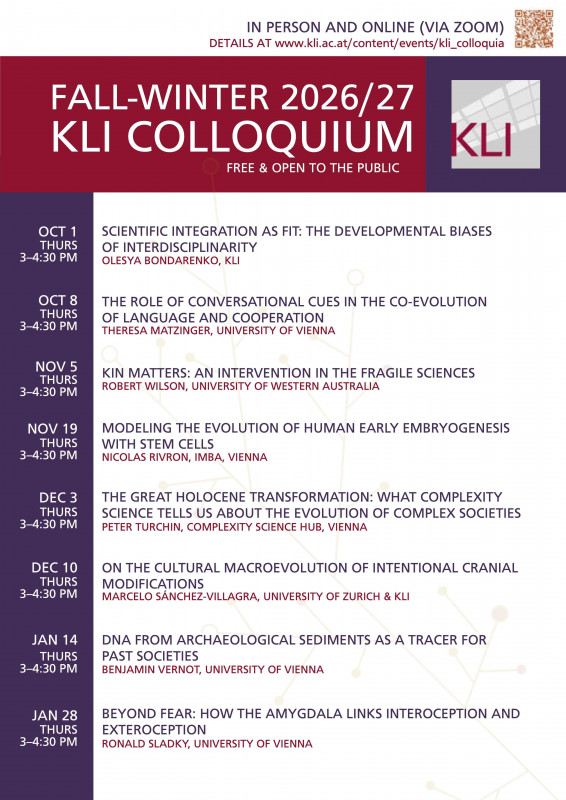
Scientific Integration as Fit: The Developmental Biases of Interdisciplinarity
Olesya BONDARENKO (KLI)
8 October 2026 (Thurs) 3-4:30 PM CET
The Role of Conversational Cues in the Co-Evolution of Language and Cooperation
Theresa MATZINGER (University of Vienna)
5 November 2026 (Thurs) 3-4:30 PM CET
Kin Matters: An Intervention in the Fragile Sciences
Robert A. WILSON (University of Western Australia)
19 November 2026 (Thurs) 3-4:30 PM CET
Modeling the Evolution of Human Early Embryogenesis with Stem Cells
Nicolas RIVRON (Institute of Molecular Biotechnology/IMBA, Vienna)
3 December 2026 (Thurs) 3-4:30 PM CET
Peter TURCHIN (Complexity Science Hub, Vienna)
10 December 2026 (Thurs) 3-4:30 PM CET
On the Cultural Macroevolution of Intentional Cranial Modifications
Marcelo SÁNCHEZ-VILLAGRA (University of Zurich)
14 January 2027 (Thurs) 3-4:30 PM CET
DNA from Archaeological Sediments as a Tracer for Past Societies
Benjamin VERNOT (University of Vienna)
28 January 2027 (Thurs) 3-4:30 PM CET
Beyond Fear: How the Amygdala Links Interoception and Exteroception
Ronald SLADKY (University of Vienna)
KLI Colloquia 2014 – 2026
Event Details

Topic description:
Multicellularity raises conceptual challenges for understanding organisms. Although multicellular (MC) systems come in different characters and in various types and forms, almost all MC associations (from biofilms to full-fledged MC systems) exhibit some kind of integration that in turn allows them to maintain their organization and to increase the possibility of survival of their constituting units and of the systems themselves, as a whole. Notwithstanding the resulting adaptation at the global level, I argue (contrary to neo-Darwinian and adaptationist approaches) that not all types of MC integration can be considered organismal. Specifically, I will argue that other explanatory frameworks reduce integration to adaptation, and as such: (i) they do not bear any distinctive power with respect to the strikingly different characters of multicellularity; (ii) they cannot fully account for nor distinguish between the individual and/or the organismal status of MC systems. I discuss three types of coordination of the interaction of MC systems with their environments (representing almost all cases in nature), and I explain that each coordination yields qualitatively different organizational requirements. I suggest that the related interactions are genuinely attributable to the whole MC organization only when the latter is integrated on the basis of a special regulatory subsystem. I argue that in contrast to all other MC cases as well as to all unicellular organizations, the endogenous production and operation of such a regulatory subsystem entails a genuine form of ‘functional integration.’ I discuss in detail the ontological consequences of such an MC organization with respect to both its constitutive (developmental and metabolic) and interactive dimension. I conclude with several implications regarding: (a) the transition from uni- to multi-cellular organizations; (b) the relation between adaptation and normativity at the MC level; (c) the distinction between functional individuals and organisms; (d) the individual/organismal status of several ‘in-between’ cases of MC systems; (e) the evolution of organismal complexity in biology.
Biographical note:
Argyris Arnellos is a Postdoctoral Fellow at the KLI and was previously a Marie Curie Postdoctoral Fellow at the IAS-Research Centre for Life, Mind and Society (Department of Logic and Philosophy of Science, University of the Basque Country). He was also a researcher and lecturer in the department of Product and Systems Design Engineering at the University of the Aegean in Syros, Greece. His current line of research is centered on the role of the notion of autonomy in integrating constitutive and interactive aspects of multicellular organisms, with a focus on developmental regulatory mechanisms and their role in the self-construction of multicellular organizations, and in the formation of complex body plans and their resulting behaviors. His PhD was on The Emergence of Meaning in Autonomous Agents and in Artificial Environments. He has published in several scientific journals and participated in numerous international and national conferences in the areas of autonomous and complex systems, 2nd-order cybernetics, philosophy of biology, philosophy of mind, and interactivism, design theory, artificial intelligence, and human-computer interaction.
