

KLI Colloquia are invited research talks of about an hour followed by 30 min discussion. The talks are held in English, open to the public, and offered in hybrid format.
Join via Zoom:
https://us02web.zoom.us/j/5881861923?omn=85945744831
Meeting ID: 588 186 1923
Fall-Winter 2026/27 KLI Colloquium Series
1 October 2026 (Thurs) 3-4:30 PM CET 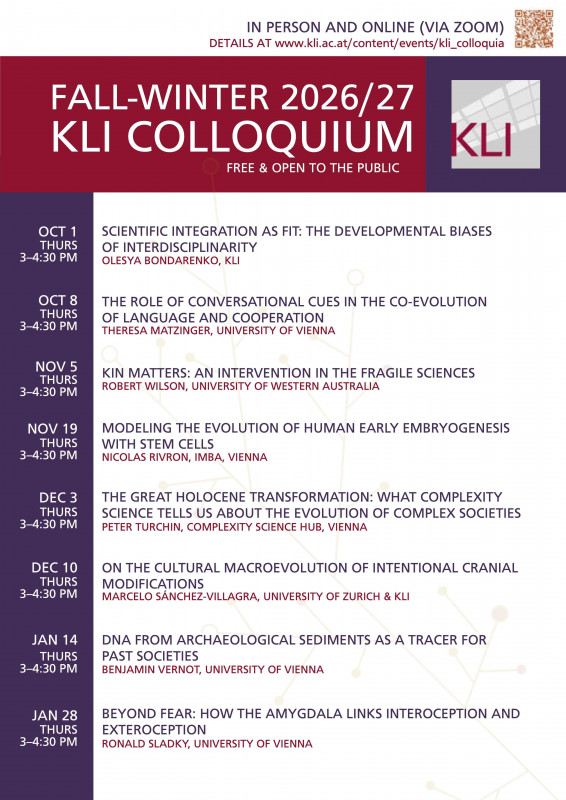
Scientific Integration as Fit: The Developmental Biases of Interdisciplinarity
Olesya BONDARENKO (KLI)
8 October 2026 (Thurs) 3-4:30 PM CET
The Role of Conversational Cues in the Co-Evolution of Language and Cooperation
Theresa MATZINGER (University of Vienna)
5 November 2026 (Thurs) 3-4:30 PM CET
Kin Matters: An Intervention in the Fragile Sciences
Robert A. WILSON (University of Western Australia)
19 November 2026 (Thurs) 3-4:30 PM CET
Modeling the Evolution of Human Early Embryogenesis with Stem Cells
Nicolas RIVRON (Institute of Molecular Biotechnology/IMBA, Vienna)
3 December 2026 (Thurs) 3-4:30 PM CET
Peter TURCHIN (Complexity Science Hub, Vienna)
10 December 2026 (Thurs) 3-4:30 PM CET
On the Cultural Macroevolution of Intentional Cranial Modifications
Marcelo SÁNCHEZ-VILLAGRA (University of Zurich)
14 January 2027 (Thurs) 3-4:30 PM CET
DNA from Archaeological Sediments as a Tracer for Past Societies
Benjamin VERNOT (University of Vienna)
28 January 2027 (Thurs) 3-4:30 PM CET
Beyond Fear: How the Amygdala Links Interoception and Exteroception
Ronald SLADKY (University of Vienna)
KLI Colloquia 2014 – 2026
Event Details

Topic description:
A central internalism/externalism debate in evolutionary theory concerns the relative importance of natural selection versus developmental constraints. The debate merely assumes, however, that natural selection only provides externalist explanations. I propose an interactionist notion of natural selection based on the complex situations that arise from ecologically-induced development and niche construction. One reason natural selection explanations are seen as externalist is due to the assumption that a common environment is prerequisite for fitness differences to reflect differences in the dispositions of organisms to survive and reproduce. The common environment then explains the direction of evolution by natural selection. I reject the presupposition of a common environment by arguing that organism-relevant environmental differences contribute to natural selection. The current arguments for a common environment commit “averaging fallacies” (Winther, Wade, Dimond 2013). Support for an interactionist account comes from alternative characterizations of niche construction. Niche Construction Theory maintains that natural selection explanations are externalist— natural selection is a process with a causal arrow that points outside-in. Niche construction is a complementary process that instead points inside-out to contribute to the environment that selects organisms. I argue that another type of niche construction — intra-population variation in niche constructing traits— supports an interactionist notion natural selection. Richard Lewontin’s Dialectical Biology and Denis Walsh’s elaboration of Lewontin’s account with JJ Gibson’s theory of ecological affordance lends further support to an interactionist view. An interactionist theory of natural selection breaks the internalist vs. externalist dichotomy on evolutionary explanations.
Biographical note:
Lynn Chiu is currently completing her Ph.D. at University of Missouri in Philosophy of Biology. She has a M.S. in Psychology and a B.S. in Life Sciences. She was a Writing-Up Fellow at the KLI in late 2013, and is currently a Visitor of the KLI Institute as well as a visiting Ph.D. student at University of Vienna.
