

KLI Colloquia are invited research talks of about an hour followed by 30 min discussion. The talks are held in English, open to the public, and offered in hybrid format.
Join via Zoom:
https://us02web.zoom.us/j/5881861923?omn=85945744831
Meeting ID: 588 186 1923
Fall-Winter 2026/27 KLI Colloquium Series
1 October 2026 (Thurs) 3-4:30 PM CET 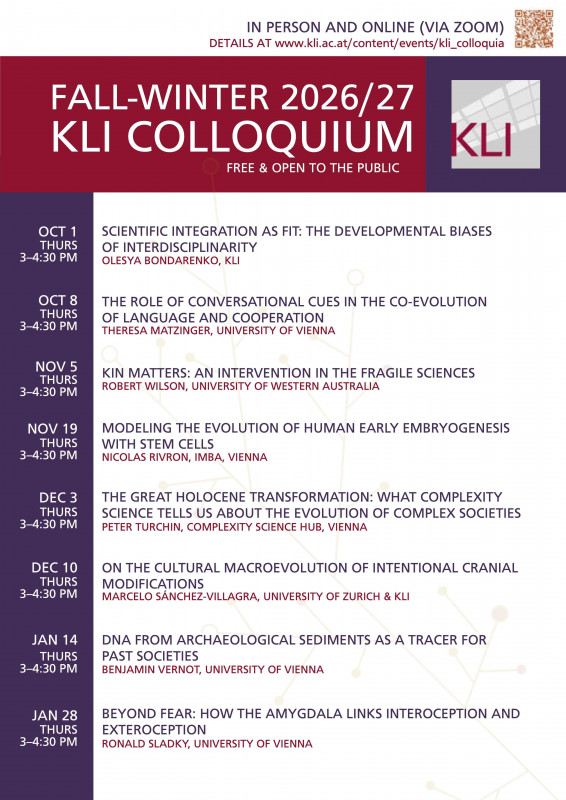
Scientific Integration as Fit: The Developmental Biases of Interdisciplinarity
Olesya BONDARENKO (KLI)
8 October 2026 (Thurs) 3-4:30 PM CET
The Role of Conversational Cues in the Co-Evolution of Language and Cooperation
Theresa MATZINGER (University of Vienna)
5 November 2026 (Thurs) 3-4:30 PM CET
Kin Matters: An Intervention in the Fragile Sciences
Robert A. WILSON (University of Western Australia)
19 November 2026 (Thurs) 3-4:30 PM CET
Modeling the Evolution of Human Early Embryogenesis with Stem Cells
Nicolas RIVRON (Institute of Molecular Biotechnology/IMBA, Vienna)
3 December 2026 (Thurs) 3-4:30 PM CET
Peter TURCHIN (Complexity Science Hub, Vienna)
10 December 2026 (Thurs) 3-4:30 PM CET
On the Cultural Macroevolution of Intentional Cranial Modifications
Marcelo SÁNCHEZ-VILLAGRA (University of Zurich)
14 January 2027 (Thurs) 3-4:30 PM CET
DNA from Archaeological Sediments as a Tracer for Past Societies
Benjamin VERNOT (University of Vienna)
28 January 2027 (Thurs) 3-4:30 PM CET
Beyond Fear: How the Amygdala Links Interoception and Exteroception
Ronald SLADKY (University of Vienna)
KLI Colloquia 2014 – 2026
Event Details

Topic description:
I am interested in the developmental processes that produce phenotypes and their highly non-random distribution in evolving populations. We must gain a mechanistic (causal) understanding of these processes—at all levels, from the molecular to the organismic—if we are to fully grasp the nature of evolutionary change. To achieve this, my research group takes a perspective that focusses explicitly on the regulatory structure of developmental systems. We closely combine quantitative experimental work with mathematical modelling in a reverse-engineering approach that aims to identify and characterise conserved versus divergent aspects of evolving regulatory networks. As a case study, we use the gap gene network in dipteran insects (flies and midges), which is involved in determining the segmented body plan of the animal during early development. Over the past eight years, we have carried out an integrative comparative analysis of the gap gene network in the model system Drosophila melanogaster, and two non-model dipterans: the scuttle fly Megaselia abdita, and the moth midge Clogmia albipunctata. Our work reveals that dynamic gap gene expression in Drosophila is driven by an underlying damped oscillator mechanism, suggesting that the parallel mode of segment determination observed in flies is much more similar to the ancestral sequential mode of segmentation than previously thought. Furthermore, we show that the gap gene network evolves through a quantitative form of developmental system drift. While overall regulatory structure is conserved between Drosophila and Megaselia, the strength of specific interactions differs markedly between the two species. This leads to changes in gap gene expression dynamics that allow the system to compensate for different maternal inputs. We believe that this kind of data-driven analysis of an evolving developmental system constitutes an important advance for EvoDevo, shifting focus from expression dynamics of single genes to the level of regulatory systems.
Biographical note:
Johannes Jaeger is an EvoDevo researcher and systems biologist who is interested in the evolution of developmental regulatory networks, structuralist approaches to the study of development and evolution, and process philosophy in general. He has worked in the fields of developmental genetics (with Walter Gehring in Basel), holistic science (with Brian Goodwin at Schumacher College), network modelling and data quantification (with John Reinitz at Stony Brook University), and EvoDevo (with Michael Akam in Cambridge). His research group at the Centre for Genomic Regulation (CRG) in Barcelona is using a reverse-engineering approach to study the evolution of the gap gene system and other regulatory networks in dipteran insects (flies and midges). Johannes is a 2014/15 fellow at the Wissenschaftskolleg zu Berlin, where he attempts to broaden his horizons by exploring the role of dogmatic thinking in ethics and science.
