

KLI Colloquia are invited research talks of about an hour followed by 30 min discussion. The talks are held in English, open to the public, and offered in hybrid format.
Join via Zoom:
https://us02web.zoom.us/j/5881861923?omn=85945744831
Meeting ID: 588 186 1923
Fall-Winter 2026/27 KLI Colloquium Series
1 October 2026 (Thurs) 3-4:30 PM CET 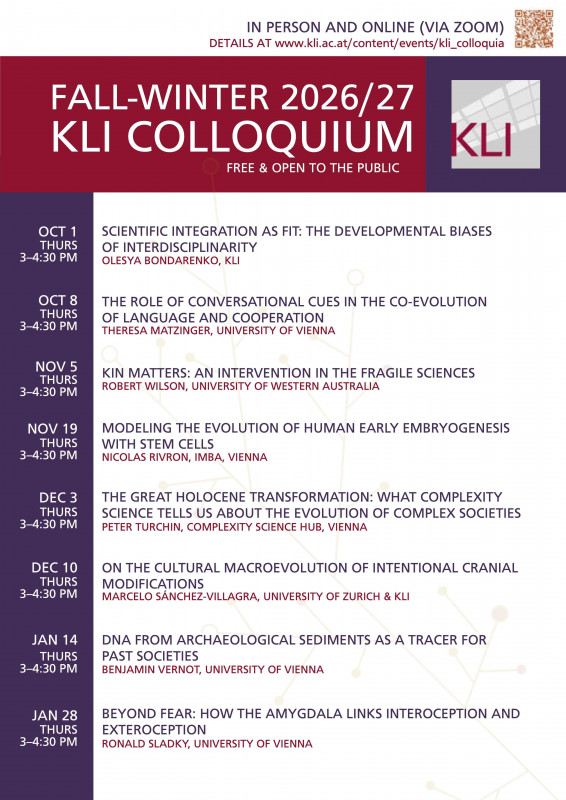
Scientific Integration as Fit: The Developmental Biases of Interdisciplinarity
Olesya BONDARENKO (KLI)
8 October 2026 (Thurs) 3-4:30 PM CET
The Role of Conversational Cues in the Co-Evolution of Language and Cooperation
Theresa MATZINGER (University of Vienna)
5 November 2026 (Thurs) 3-4:30 PM CET
Kin Matters: An Intervention in the Fragile Sciences
Robert A. WILSON (University of Western Australia)
19 November 2026 (Thurs) 3-4:30 PM CET
Modeling the Evolution of Human Early Embryogenesis with Stem Cells
Nicolas RIVRON (Institute of Molecular Biotechnology/IMBA, Vienna)
3 December 2026 (Thurs) 3-4:30 PM CET
Peter TURCHIN (Complexity Science Hub, Vienna)
10 December 2026 (Thurs) 3-4:30 PM CET
On the Cultural Macroevolution of Intentional Cranial Modifications
Marcelo SÁNCHEZ-VILLAGRA (University of Zurich)
14 January 2027 (Thurs) 3-4:30 PM CET
DNA from Archaeological Sediments as a Tracer for Past Societies
Benjamin VERNOT (University of Vienna)
28 January 2027 (Thurs) 3-4:30 PM CET
Beyond Fear: How the Amygdala Links Interoception and Exteroception
Ronald SLADKY (University of Vienna)
KLI Colloquia 2014 – 2026
Event Details

Topic description:
In 1875—one year after the foundation of the Naples Station—C. Claus and F. E. Schulze established a zoological station in Trieste. The Trieste Station was a branch of the University of Vienna, which provided biologists with facilities and supplies to accomplish their field studies by the Adriatic sea. The Trieste Station gathered scholars from all Mitteleuropa, including B. Hatschek, A. Steuer, K. Grobben, Sigmund Freud, I. Metschinkoff, and many more. Results of research conducted in Trieste were mainly published in the journals Arbeiten aus den Zoologischen Instituten der Universität Wien und der Zoologischen Station in Triest, Sitzungsberichte der Preussischen Akademie der Wissenschaften, and Bollettino della Società Adriatica di Scienze Naturali di Trieste. Due to the consequences of World War I, the Trieste Station was closed in 1915 and all of its material was moved elsewhere. Ever since, different institutions appeared in Trieste to replace the Trieste Station, with slightly different research programs, but none of them shared with the Trieste Station its original philosophy of serving a diverse community of scientists. Between the last three decades of the nineteenth century and the early twentieth century, many marine institutions arose all over the world to permit biologists to experiment on evolution, development, and environment. Although literature on marine stations and laboratories is rather exhaustive and details well the history of those particular institutions, the Trieste Station still lacks a comprehensive and coherent historical investigation. For my doctoral research, I aim to shed light on the network of scientists traveling between southern European institutions, including Vienna, Trieste, and Naples, and researching on evolution, development, and environment. In particular, I focus on the institutional history of the Trieste Station to understand the research and experimental programs run in Trieste.
Biographical note:
Federica Turriziani Colonna is a PhD student in Biology and Society at Arizona State University, and a Junior Visiting Fellow at the KLI Institute. With a background in philosophy, she focuses her doctoral research on the history of biology. She currently works as an editor for the ASU’s Embryo Project Encyclopedia.
