
KLI Colloquia are invited research talks of about an hour followed by 30 min discussion. The talks are held in English, open to the public, and offered in hybrid format.
Join via Zoom:
https://us02web.zoom.us/j/5881861923?omn=85945744831
Meeting ID: 588 186 1923
Fall-Winter 2026/27 KLI Colloquium Series
1 October 2026 (Thurs) 3-4:30 PM CET 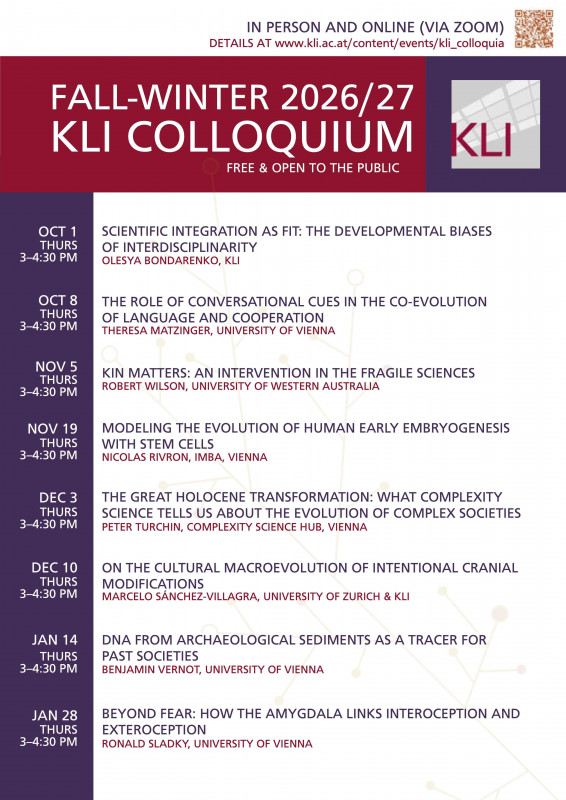
Scientific Integration as Fit: The Developmental Biases of Interdisciplinarity
Olesya BONDARENKO (KLI)
8 October 2026 (Thurs) 3-4:30 PM CET
The Role of Conversational Cues in the Co-Evolution of Language and Cooperation
Theresa MATZINGER (University of Vienna)
5 November 2026 (Thurs) 3-4:30 PM CET
Kin Matters: An Intervention in the Fragile Sciences
Robert A. WILSON (University of Western Australia)
19 November 2026 (Thurs) 3-4:30 PM CET
Modeling the Evolution of Human Early Embryogenesis with Stem Cells
Nicolas RIVRON (Institute of Molecular Biotechnology/IMBA, Vienna)
3 December 2026 (Thurs) 3-4:30 PM CET
Peter TURCHIN (Complexity Science Hub, Vienna)
10 December 2026 (Thurs) 3-4:30 PM CET
On the Cultural Macroevolution of Intentional Cranial Modifications
Marcelo SÁNCHEZ-VILLAGRA (University of Zurich)
14 January 2027 (Thurs) 3-4:30 PM CET
DNA from Archaeological Sediments as a Tracer for Past Societies
Benjamin VERNOT (University of Vienna)
28 January 2027 (Thurs) 3-4:30 PM CET
Beyond Fear: How the Amygdala Links Interoception and Exteroception
Ronald SLADKY (University of Vienna)
KLI Colloquia 2014 – 2026
Event Details
Topic description:
The quantification of temperature was a long and difficult process. After many centuries of being a qualitative concept of hot/cold in quotidian and Aristotelian ways of thinking, temperature began to be quantified in the early 17th century with the invention of the first thermometers. However, the numbers given by early thermometers were not only unstandardized across different instruments, but also not proper numbers amenable to arithmetic operations even for each of the instruments (sometimes designated, for this reason, as "thermoscopes" rather than "thermometers"). The true quantification of temperature required the establishment of some basic laws of thermal physics, the verification of which required an already-quantified empirical concept of temperature. This circularity could only be resolved by the method of "epistemic iteration."
Biographical note:
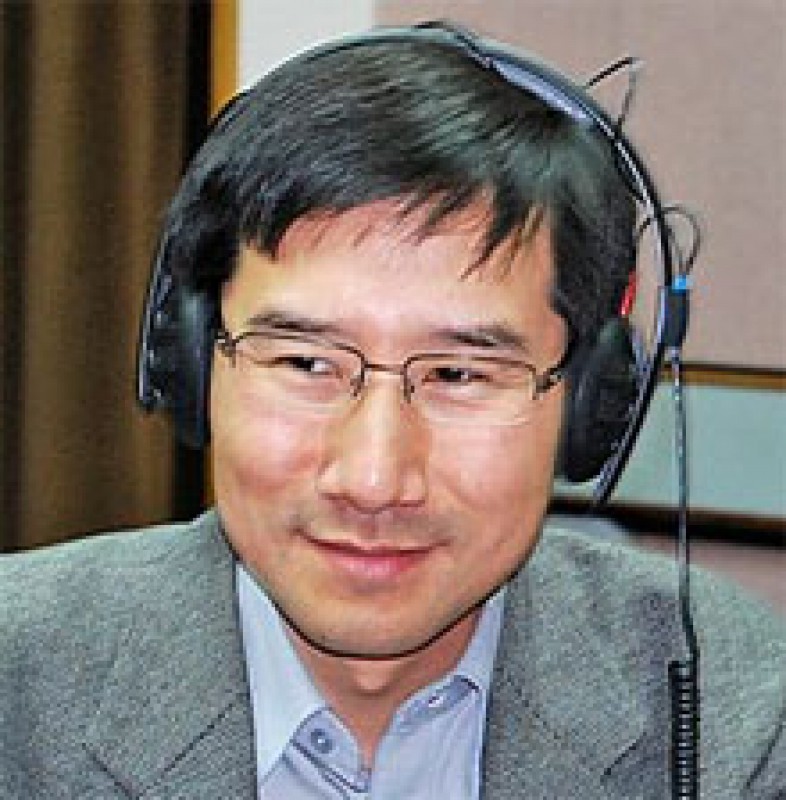
Hasok Chang is Hans Rausing Professor of History and Philosophy of Science at the University of Cambridge. Previously he taught for 15 years at University College London, after receiving his PhD in Philosophy at Stanford University following an undergraduate degree at the California Institute of Technology. He is the author of Is Water H2O? Evidence, Realism and Pluralism (Springer, 2012), winner of the 2013 Fernando Gil International Prize, and Inventing Temperature: Measurement and Scientific Progress (Oxford University Press, 2004), joint winner of the 2006 Lakatos Award. He is also co-editor (with Catherine Jackson) of An Element of Controversy: The Life of Chlorine in Science, Medicine, Technology and War (British Society for the History of Science, 2007), a collection of original work by undergraduate students at University College London. He is a co-founder of the Society for Philosophy of Science in Practice (SPSP), and the International Committee for Integrated History and Philosophy of Science. Currently he is the President of the British Society for this History of Science.
