

KLI Colloquia are invited research talks of about an hour followed by 30 min discussion. The talks are held in English, open to the public, and offered in hybrid format.
Join via Zoom:
https://us02web.zoom.us/j/5881861923?omn=85945744831
Meeting ID: 588 186 1923
Spring-Summer 2026 KLI Colloquium Series
12 March 2026 (Thurs) 3-4:30 PM CET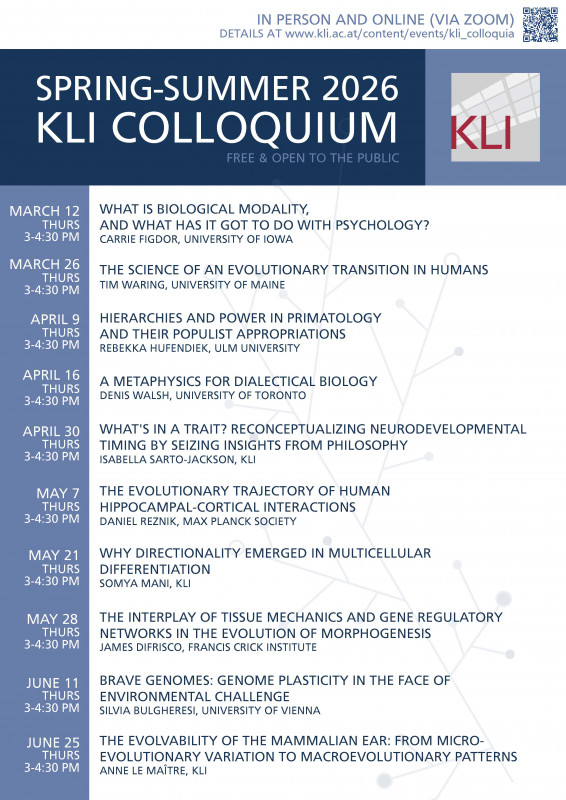
What Is Biological Modality, and What Has It Got to Do With Psychology?
Carrie Figdor (University of Iowa)
26 March 2026 (Thurs) 3-4:30 PM CET
The Science of an Evolutionary Transition in Humans
Tim Waring (University of Maine)
9 April 2026 (Thurs) 3-4:30 PM CET
Hierarchies and Power in Primatology and Their Populist Appropriation
Rebekka Hufendiek (Ulm University)
16 April 2026 (Thurs) 3-4:30 PM CET
A Metaphysics for Dialectical Biology
Denis Walsh (University of Toronto)
30 April 2026 (Thurs) 3-4:30 PM CET
What's in a Trait? Reconceptualizing Neurodevelopmental Timing by Seizing Insights From Philosophy
Isabella Sarto-Jackson (KLI)
7 May 2026 (Thurs) 3-4:30 PM CET
The Evolutionary Trajectory of Human Hippocampal-Cortical Interactions
Daniel Reznik (Max Planck Society)
21 May 2026 (Thurs) 3-4:30 PM CET
Why Directionality Emerged in Multicellular Differentiation
Somya Mani (KLI)
28 May 2026 (Thurs) 3-4:30 PM CET
The Interplay of Tissue Mechanics and Gene Regulatory Networks in the Evolution of Morphogenesis
James DiFrisco (Francis Crick Institute)
11 June 2026 (Thurs) 3-4:30 PM CET
Brave Genomes: Genome Plasticity in the Face of Environmental Challenge
Silvia Bulgheresi (University of Vienna)
25 June 2026 (Thurs) 3-4:30 PM CET
Anne LeMaitre (KLI)
KLI Colloquia 2014 – 2026
Event Details

Topic description:
While evolutionary developmental biology (EvoDevo) has had a big impact upon our understanding and study of morphological evolution, the uptake of the EvoDevo perspective more broadly has been patchy. Discussions of evolvability, evolutionary innovation, and evolutionary novelty beyond the morphological realm remain few and far between. While this is the case, there is no in-principle impediment to applications of the EvoDevo perspective to other domains, for example, behavioral, cultural, and cognitive evolution (Brown 2014). In this light, here, I offer a preliminary analysis of cultural evolution from an EvoDevo perspective. In the first half of the paper, I outline two approaches to understanding cultural traits from an EvoDevo perspective. In the second half, I use one of these approaches to develop a number of general hypotheses regarding the features of populations indicative of “cultural evolvability.”
Biographical note:
Rachael Brown works primarily at the intersection of the philosophy of biology, philosophy of cognitive science, and philosophy of science. Her research todate has focused on methodological and theoretical issues in evolutionary biology and the study of animal behavior. Rachael holds a BA (Hons) and BSc from the University of Melbourne and a PhD (2013) from the Australian National University. She was a Writing-Up Fellow at the KLI in 2011 and is currently a Postdoctoral Fellow in Science and Philosophy at the Rotman Institute for Philosophy at the University of Western Ontario in Canada. In July 2014 will take up a lectureship in Mind & Metaphysics at Macquarie University in Sydney, Australia. Rachael’s full CV and publications are available at her website: http://rachaelbrown.net
