

KLI Colloquia are invited research talks of about an hour followed by 30 min discussion. The talks are held in English, open to the public, and offered in hybrid format.
Join via Zoom:
https://us02web.zoom.us/j/5881861923?omn=85945744831
Meeting ID: 588 186 1923
Fall-Winter 2026/27 KLI Colloquium Series
1 October 2026 (Thurs) 3-4:30 PM CET 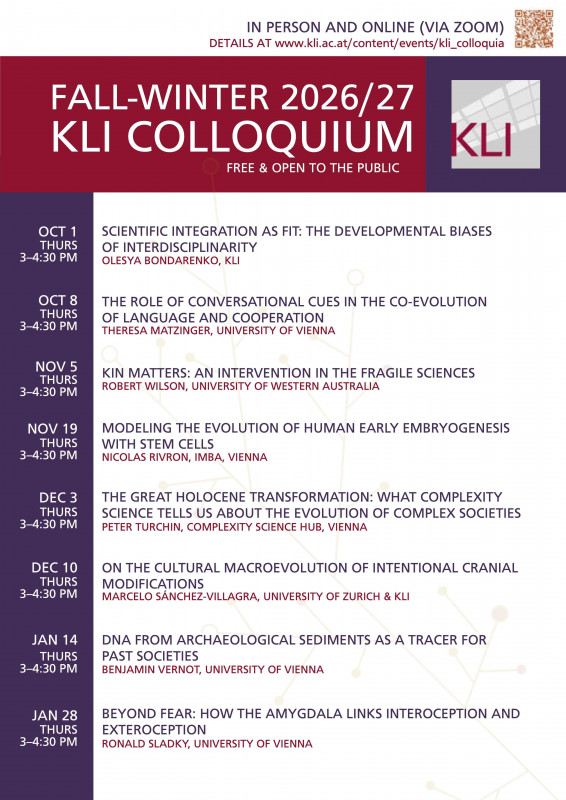
Scientific Integration as Fit: The Developmental Biases of Interdisciplinarity
Olesya BONDARENKO (KLI)
8 October 2026 (Thurs) 3-4:30 PM CET
The Role of Conversational Cues in the Co-Evolution of Language and Cooperation
Theresa MATZINGER (University of Vienna)
5 November 2026 (Thurs) 3-4:30 PM CET
Kin Matters: An Intervention in the Fragile Sciences
Robert A. WILSON (University of Western Australia)
19 November 2026 (Thurs) 3-4:30 PM CET
Modeling the Evolution of Human Early Embryogenesis with Stem Cells
Nicolas RIVRON (Institute of Molecular Biotechnology/IMBA, Vienna)
3 December 2026 (Thurs) 3-4:30 PM CET
Peter TURCHIN (Complexity Science Hub, Vienna)
10 December 2026 (Thurs) 3-4:30 PM CET
On the Cultural Macroevolution of Intentional Cranial Modifications
Marcelo SÁNCHEZ-VILLAGRA (University of Zurich)
14 January 2027 (Thurs) 3-4:30 PM CET
DNA from Archaeological Sediments as a Tracer for Past Societies
Benjamin VERNOT (University of Vienna)
28 January 2027 (Thurs) 3-4:30 PM CET
Beyond Fear: How the Amygdala Links Interoception and Exteroception
Ronald SLADKY (University of Vienna)
KLI Colloquia 2014 – 2026
Event Details
Topic description:
Theoretical morphospaces are multidimensional spaces produced by systematically varying the parameter values of a mathematical model of form. Theoretical morphospaces can be used not only to simulate existent morphology, but also to create nonexistent morphology, morphology that is geometrically possible but that has never been utilized in the evolution of life. Plotting the actual distribution of the existent morphologies for a group of organisms within a theoretical morphospace can reveal empty, unutilized regions of morphospace that are the product of evolutionary constraint. Two classes of evolutionary constraint are here recognized: extrinsic and intrinsic. Extrinsic constraints are those imposed by the laws of physics and geometry. Extrinsic constraints exist whether any actual biological form encounters them or not. The class of extrinsic constraints is subdivided into geometric constraints and functional constraints. Intrinsic constraints are those imposed by the biology of a specific organism. Intrinsic constraints do not exist in the absence of an actual organism. At least two conceptually different types of intrinsic constraint exist: phylogenetic constraint and developmental constraint. Theoretical morphospaces allow us to reconsider the concept of evolutionary constraint from a spatial perspective. For a given group of organisms, the distributional boundaries of geometric, functional, phylogenetic, and developmental constraint may be actually mapped within a theoretical morphospace. Each type of constraint can be defined explicitlyby the set of forms contained within the distributional boundaries of that particular constraint within form hyperspace, and formalized by the usage of Venn diagrams and set theory notation. The extrinsic constraint boundaries of geometric and functional constraint in form hyperspace are absolute and do not vary with time. That is, the laws of geometry and the physics of swimming are the same today as they were 100 million years ago. This is not true of intrinsic constraint boundaries. Both phylogenetic constraint boundaries and developmental constraint boundaries are intrinsic to the biology of specific organisms and, as organisms evolve with time, their intrinsic constraint boundaries may evolve as well. The analytic techniques of theoretical morphology are particularly powerful when applied to extrinsic constraints, those of geometry and function. They can be used to help analyze the intrinsic constraints of phylogeny and development as well, but the addition of the time dimension adds considerably more indeterminancy to the analysis.
Biographical note:
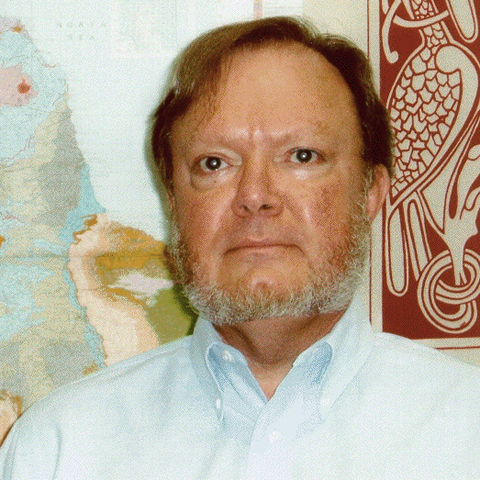
George McGhee is currently Professor of Paleobiology at Rutgers University (New Brunswick, New Jersey, USA), where he is a member of the Geological Sciences, Ecology & Evolution, and Oceanography graduate faculties. McGhee completed the Master’s degree in paleontology at the University of North Carolina at Chapel Hill, and the PhD. at the University of Rochester, working under the direction of Professor David M. Raup. He conducted Pre-Doctoral research with Professor Adolf Seilacher’s Konstruktionsmorphologie research group at the University of Tübingen, and following his doctoral work he has held the positions of Visiting Scientist at the Field Museum of Natural History (Chicago), Research Associate at the American Museum of Natural History (New York), Visiting Professor at the University of Tübingen, and Fellow at the Konrad Lorenz Institute for Evolution and Cognition Research. Dr. McGhee is the author of over 120 research publications, and of the research books "The Late Devonian Mass Extinction," and "Theoretical Morphology: The Concept and Ist Applications," both published by Columbia UP.
